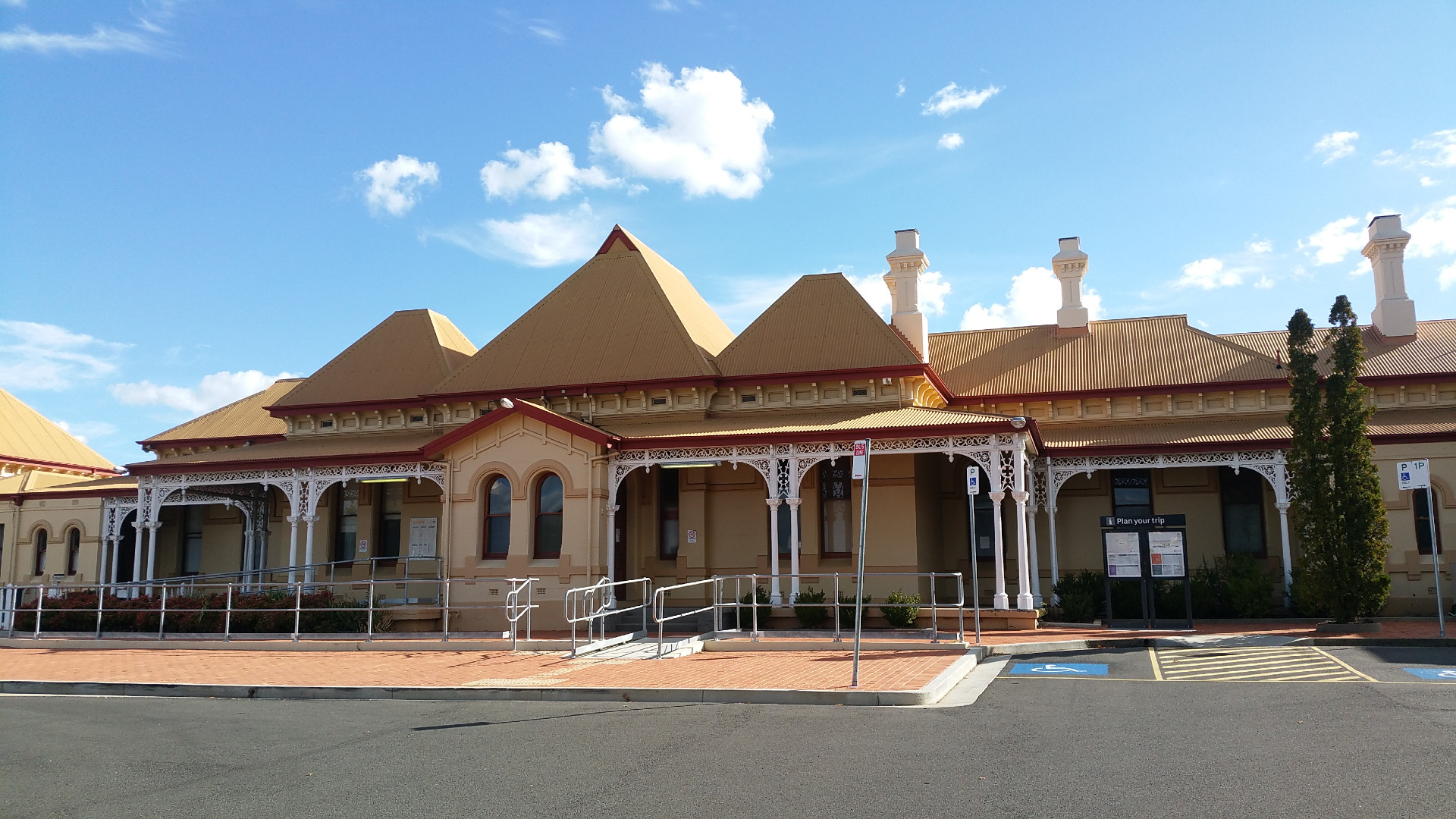
Scholarly Australian railway historiography typically has dealt with rather traditional themes such as departmental administration, network expansion and associated contention, inter-colonial rivalries, engineering challenges, biographical interpretation and so forth.1For general studies of railway development in NSW see Robert Lee, The greatest public work: the New South Wales railways, 1848–1889, Sydney, 1988; John Gunn, Along parallel lines: a history of the railways of New South Wales 1850–1986, Carlton, 1989; David Burke, Making the railways, Sydney, 1995. While labour historians have explored industrial relations and associated political culture,2See, for example, Mark Hearn, Working lives: a history of the Australian Railways Union (NSW Branch), Sydney, 1990; Lucy Taksa, ‘Technology, Work, Gender and Citizenship at the Eveleigh Railway Workshops Precinct’, Labour History, Vol. 76, 1999, pp. 153–62; Joseph Stark, ‘The Australian Railways Union and Rank and File Democracy in New South Wales, 1925–60’, Labour History, Vol. 128, 2025, pp. 109–30. the first century of railway development tends to be a story of progress and triumph over the hostile Australian environment. In popular histories, in various media, the subsequent decline in railway operations has inspired considerable nostalgia for the steam era.3David Burke, Great steam trains of Australia, Adelaide, 1978; Jim Revitt, The magic of steam: a guide to steam trains working in Australia, Sydney, 1992; Tim Fischer, Steam Australia: locomotives that galvanised the nation, Canberra, 2018. As elsewhere, a substantial but primarily descriptive enthusiast literature is dedicated to rolling stock, infrastructure and so forth.4See, for example, publications of the Australian Railway History Historical Society (NSW Division). Less studied are the socio-cultural impacts of railways—particularly at the local level.5The situation is somewhat different internationally: see various approaches in Harold Perkin, The age of the railway, London, 1970; Jeffrey Richards and John M. MacKenzie, The railway station: a social history, Oxford, 1986; Nicholas Faith, The world the railways made, London, 1990; Michael Freeman, Railways and the Victorian imagination, New Haven, 1999. This essay examines one aspect of a forgotten history: the civic celebrations accompanying the opening of Armidale’s Railway Station in Northern New South Wales (NSW) in early 1883. Apart from passing mention in local histories, little research has been done upon these festivities. However, the advent of the railway repeatedly was understood as the most important event in many Australian towns’ short histories.6For typical examples see railway opening reports in the Maitland Mercury, 31 March 1857, p. 2 (Maitland), Goulburn Herald, 22 May 1869, p. 4 (Goulburn); Ovens and Murray Advertiser, 30 September 1876, p. 4 (Beechworth); compare Northern Daily Leader, 1 February 2022 (a modern newspaper account of the Tamworth opening in 1878). The celebrations that took place at Armidale also throw up some surprising twists and provide insights into evolving local politics and power relations in the early 1880s.
Early Armidale
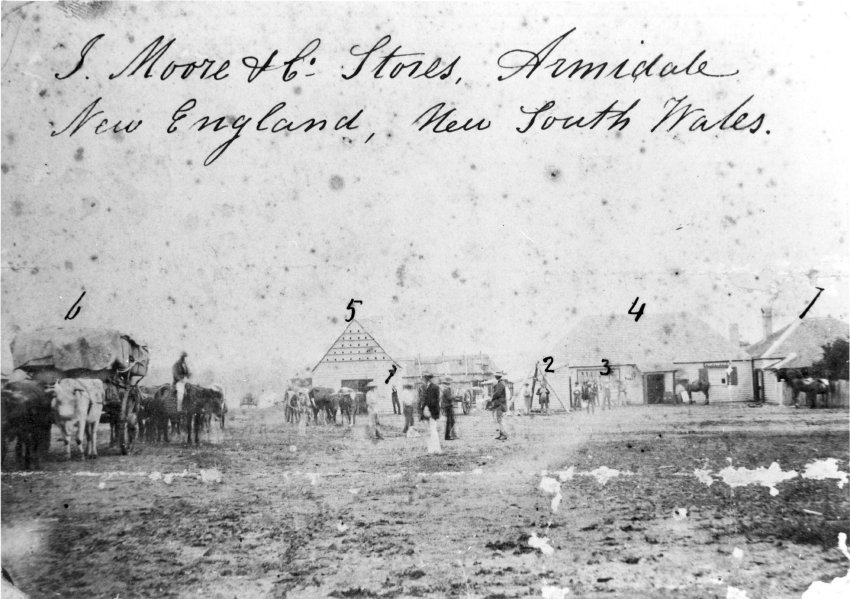
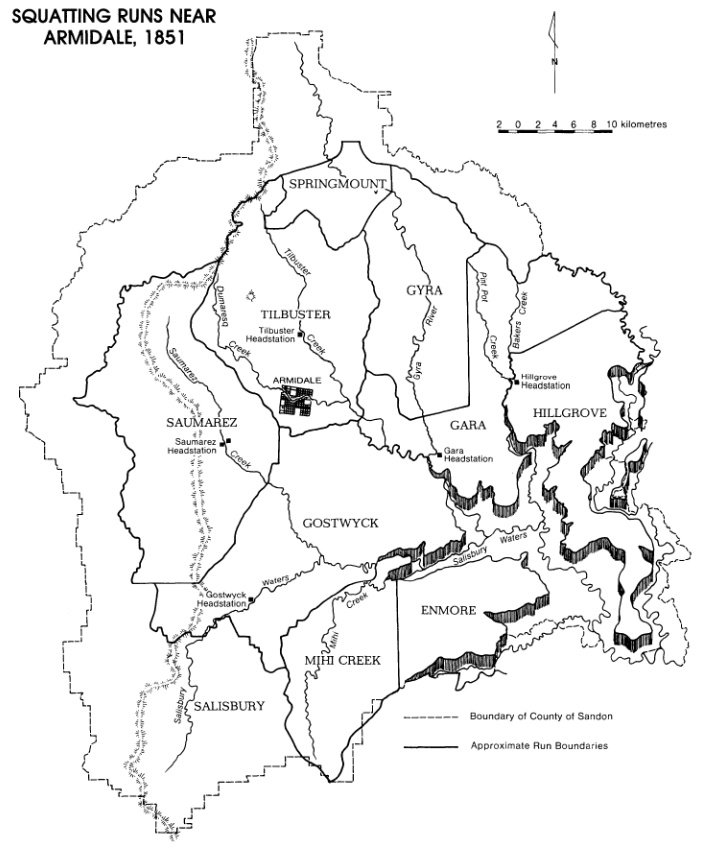
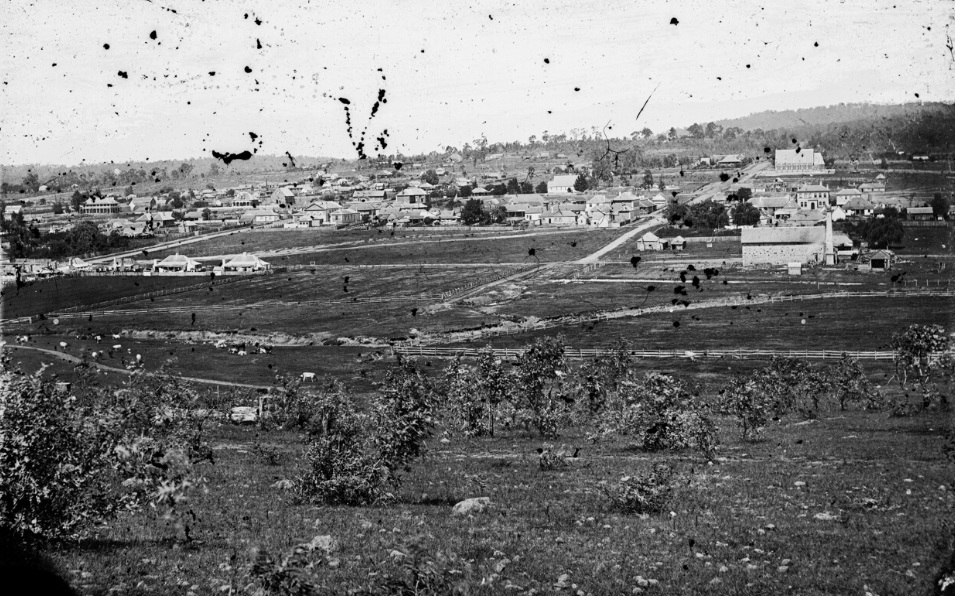
Situated on the New England or Northern Tablelands roughly half way between Sydney and Brisbane, Armidale is now one of Australia’s few university towns with a population of about 24,000.7Australian Bureau of Statistics, Armidale Quickstats, 2021 Australian Census. Traditionally lands of the Anaiwan people, the area was occupied by the British during a period of accelerated pastoral expansion in the mid 1830s.8For Aboriginal occupation see Luke Godwin, ‘Inside information: settlement and alliance in the late Holocene of Northeastern New South Wales’, PhD thesis, University of New England, 1990; for the frontier era see Callum Clayton-Dixon, Surviving New England: a history of Aboriginal resistance; resilience through the first forty years of the colonial apocalypse, Armidale, 2020. Due to the bracing winter Tablelands climate, the ‘New England’ moniker soon came into use and in 1839 the state established its first regional administrative outpost in the form of a Crown Land Commissioner’s headquarters from which Armidale developed.9For Armidale see John Ferry, Colonial Armidale, St Lucia, 1999. More generally, see R.B. Walker, Old New England: a history of the Northern Tablelands, 1818–1900, Sydney 1966 and various essays in Alan Atkinson et al., High lean country: land, people and memory in New England, Sydney, 2006. Nowadays, the ‘New England’ region typically refers to a large area encompassing the Tablelands, its western slopes and the Liverpool Plains.10On regional understandings see Alan Atkinson, ‘What is New England’ in Atkinson et al., High lean country, ch. 1. However, in the nineteenth century New England usually was synonymous with the higher Tablelands districts. Until gold was discovered in the 1850s, the region’s fledgling economy (however defined) was almost wholly dependent upon large pastoral runs (see the map below for stations in the Armidale district). Packed wool’s ability to be transported long distances without physical degradation was an important factor in the establishment and early socio-economic dominance of the pastoral sector, and the Tablelands are still associated with fine wool production.
By road, Armidale is about 480 km north of Sydney and in the nineteenth century its isolation from the capital was compounded by the primitive state of roads throughout the colony. Bullock-drawn drays could take six weeks or more to travel from Sydney or Newcastle via the Hunter Valley and the gorges of the Great Escarpment complicated access to Kempsey and Grafton, the closest coastal shipping ports.11See generally Alan Atkinson and John Atchison, ‘Travelling and Communicating’ in Atkinson et al., High lean country, ch. 18; Rex Glencross Grant, ‘Dray to steamer: road transport connections between coast and Tablelands in Northern NSW’, Australian Journal of Multi-Disciplinary Engineering, Vol. 7, 2009, pp. 129-36. Although the electric telegraph linked Armidale to some other Australian towns and cities from late 1861, travel to and from New England remained an uncomfortable and somewhat protracted undertaking for decades.12Armidale Express, 9 November 1861, p. 2. A time ball for public information was installed at the Courthouse when the telegraph arrived. Armidale Express, 16 November 1861, p. 2; 23 November 1861, p. 2. Regional transport development thus became a pressing local political issue and a Railway League first formed at Armidale in 1867.13Armidale Express, 21 September 1867, p. 2; Grant Harman, ‘Politics and Railway Development in New England’, Journal of the Royal Australian Historical Society, Vol. 56, Pt 4, 1970, pp. 281–95.

By this time, Armidale and other Northern towns such as Tamworth and Inverell were small but growing administrative and commercial centres. While gold mining and the transient populations it tended to support waned regionally in the 1860s, state sponsored closer settlement of pastoral runs (‘Free Selection’) increased permanent district populations around emerging towns. In the mid 1870s, tin mining became an important component of the New England economy; later, gold mining revived (primarily at Hillgrove, east of Armidale).14For Hillgrove see Graham Wilson, ‘The Growth and Decline of Hillgrove: a history of a northern New South Wales mining town from 1880 to 1920’, MA Thesis, University of Sydney, 1990. From the mid 1870s, the Great Northern Railway also began to be extended beyond the upper Hunter Valley, including a branch line that ultimately serviced north-western NSW. In fact, railway building then quickened throughout the colony, heralding a ‘golden age’ of construction.15See Gunn, Along Parallel Lines, chs. 4–5; Harman, ‘Politics and Railway Development’. The extension of the trunk line to the Queensland border was a key development in this regard.
The Great Northern Railway
Commencing operations between Newcastle and East Maitland in 1857, construction of the standard gauge Great Northern Railway (now known as the Main North[ern] Line) took more than twenty five years to reach Armidale. Further extension to the border at Jennings/Wallangarra was completed in 1888. A select chronology of Great Northern Railway extensions from Newcastle is listed below:
East Maitland (1857);
Singleton (1863);
Muswellbrook (1869);
Murrurundi (1872);
Tamworth (1878);
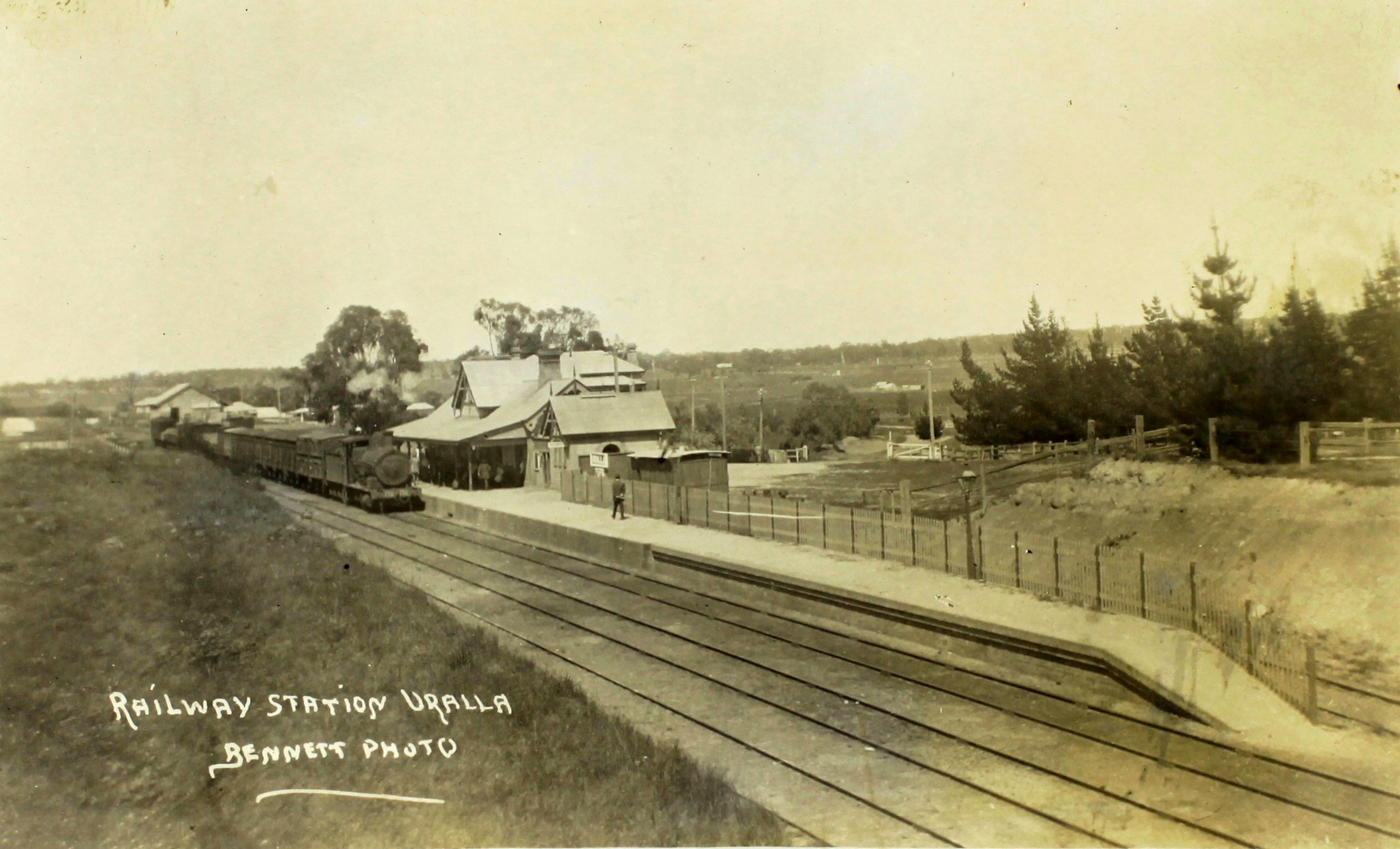
Uralla (1882);
Armidale (1883);
Glen Innes (1884);
Tenterfield (1886);
Jennings (NSW)/Wallangarra (QLD, 1888).
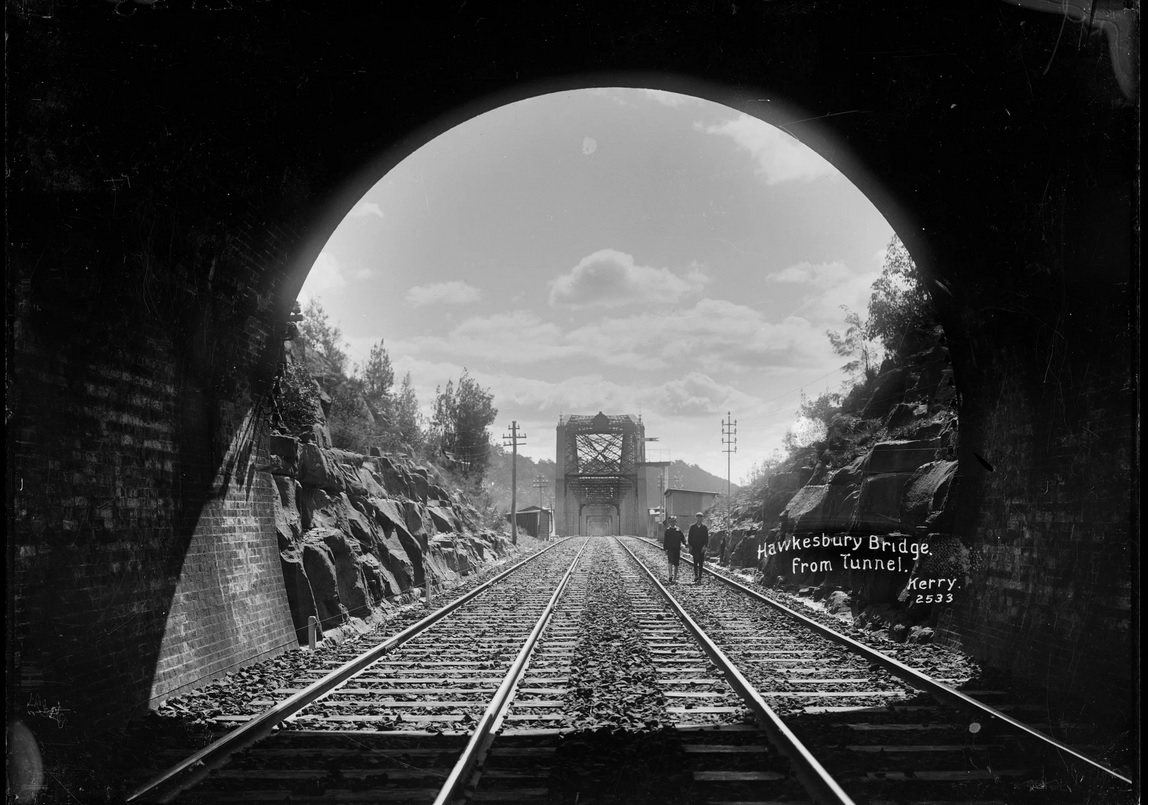
Direct railway travel between Sydney and all these communities was not achieved until the opening of the first Hawkesbury River bridge in 1889; when Armidale station opened in 1883, travellers between Sydney and Newcastle usually voyaged on coastal steamers.16See Bill Phippen, The Hawkesbury River railway bridges, Redfern, 2016. In the early 1890s, the mail train journey from Sydney to Armidale took about 12 hours; nowadays, daily NSW TrainLink passenger services take about eight hours.17Evening News, 6 June 1891. As commonly observed, completion of the Hawkesbury bridge enabled roughly 2,500 km of direct railway communication between the colonial capitals Brisbane, Sydney, Melbourne and Adelaide—notwithstanding the development of narrow gauge systems in Queensland and South Australia and broad gauge in Victoria.18Gunn, Along parallel lines, p. 210.
A satellite map of the Great Northern Railway route from Sydney to Jennings/Wallangarra is included below. A three dimensional effect can also be viewed by expanding the map to full screen, clicking on the three-dotted icon to the right of the map title and selecting ‘View Map in Google Earth’. Once the map has loaded, click ‘3D’ at bottom right to activate this viewing mode, which does a good job of demonstrating the line’s topography and modern landscape. Note that the short section from Hamilton to the historic Newcastle railway terminus (opened in 1877, but now closed) is included as this was a key element of the line when Armidale station opened in 1883. The route from Sydney to the border remained operational for about a century; however, between 1989 and 1993 passenger traffic terminated at Tamworth; since 1993, passenger traffic has terminated at Armidale (and the line north closed altogether for many years). The currently operational (Main Northern) section to Armidale is denoted in blue on the map while closed sections are denoted red. Finally, note also that the introduction in 1932 of a standard gauge coastal link between Sydney and Brisbane tended to supersede the inland route for interstate passenger travel.
As the Great Northern Railway progressed from Newcastle towards New England in the late 1870s, the projected route to the border became subject to much parochial contention—particularly in vociferously partisan town newspapers. Briefly, in May 1878 the NSW parliament approved a Tablelands route via the Armidale district, Glen Innes and Tenterfield rather than a western slopes alternative via Inverell.19Sydney Mail, 18 May 1878, p. 697. Some historians have agreed that this was a victory for wealthy pastoral interests (supposedly typifying Armidale’s and the Tablelands local economy and politics) over that of small farmers/selectors (supposedly typical of Inverell).20Harman, ‘Politics and Railway Development’; Weidemann, World of its own. This argument, of course, tends to reiterate a long-standing trope in nineteenth-century Australian rural historiography: conflict between pastoralists and small farmers following the implementation of closer settlement policies from the early-to-mid 1860s.21For NSW generally see Bill Gamage, ‘Who gained, and who was meant to gain, from land selection in New South Wales’, Historical Studies, Vol. 24, 1990, pp. 104–22. However, in my view this interpretation is somewhat misleading in respect of Armidale.
Comparative statistics cited in parliament in 1878 by the Minister of Public Works, John Sutherland, when justifying the Tablelands route decision reveal some surprising figures.22Sydney Morning Herald, 9 May 1878, p. 3. Not only were total livestock numbers and holdings much higher in Armidale than Inverell (the former by a factor of six); Armidale’s cereal produce was about double as well.23Sydney Morning Herald, 9 May 1878, p. 3. As John Ferry points out, grain growers at Inverell (and Tamworth) were more organised politically than their Tablelands counterparts;24Ferry, Colonial Armidale, p. 163. it is also true that that the Tablelands were particularly associated with relatively wealthy pastoralists (for example, the Dangars at Gostwyck and, later, the White family at Saumarez). Yet the basic facts of land use in the competing districts in the late 1870s seem to have been overlooked by earlier historians of railway development. Undeniably, comparative grain production figures changed markedly in subsequent decades but the eventual expansion of the NSW wheat belt to western New England is irrelevant to the 1870s. For our purposes, a more relevant nexus of contention was not that between small farmers and graziers—but rather between the Armidale urban/mercantile lobby and the NSW Railways administration. I’ll return to this theme below as it’s relevant to both the site chosen for Armidale’s station and the management and planning of the 1883 opening ceremony. Before doing so, a summary of line construction in the New England region is needed.
Railway Construction in New England
While Australian public railways notably have been owned and operated by the state, nineteenth-century railway building in NSW usually was undertaken by private companies contracted by the Railways Department (then a major component of the Public Works Department).25See generally Lee, The greatest public work. In the early 1880s, Australia was still relatively un-industrialised and line construction necessarily was the preserve of a relatively small pool of firms with substantial capital resources who could enlist and manage small armies of subcontracted navvies. Railway stations and associated buildings, on the other hand, typically were erected by local builders. Line construction in New England between 1879 and 1888 was divided into four main contracts:
Tamworth-Uralla (Amos Brothers);26Armidale Express, 16 May 1879, p. 3.
Uralla-Glen Innes (Proudfoot and Company);27New South Wales Government Gazette, 25 January 1881, p. 494.
Glen Innes-Tenterfield (Cobb and Company);28New South Wales Government Gazette, 27 October 1882, p. 5705.
Tenterfield-Wallangarra (Stephen and Company).29New South Wales Government Gazette, 29 January 1886, p. 737.
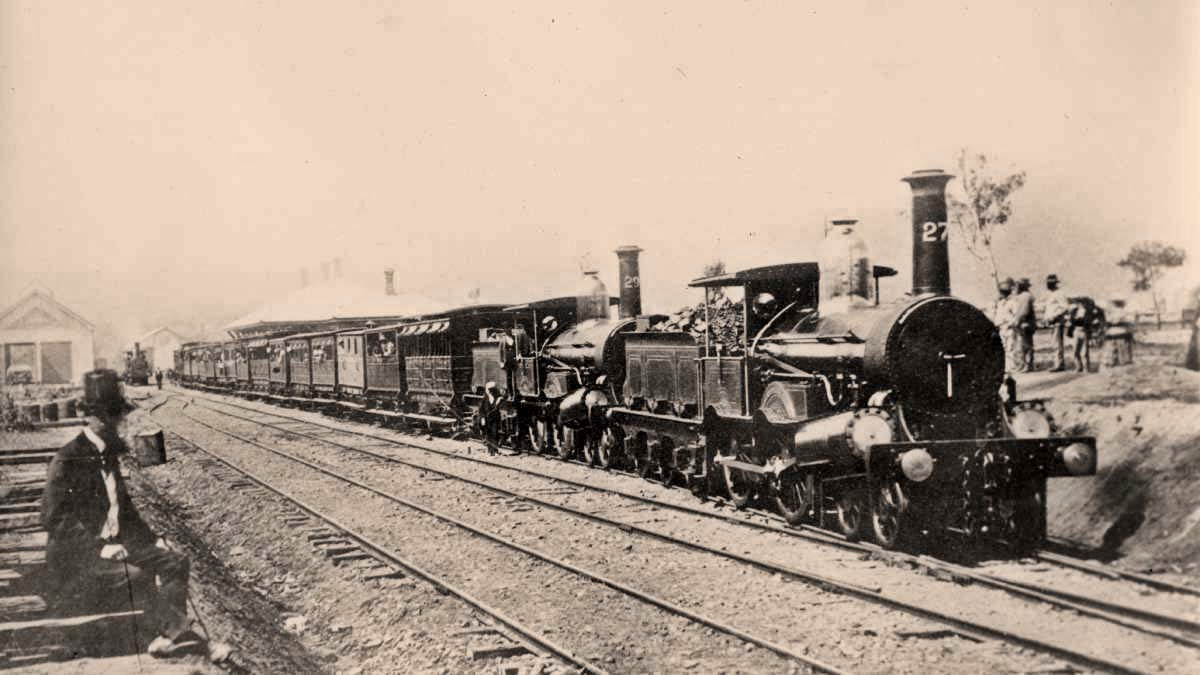
The Uralla-Glen Innes construction section including Armidale was undertaken by Proudfoot and Company whose principal, David Proudfoot (c. 1838–91), had no Australian railway building experience but had been heavily involved in railway construction in New Zealand’s south island; the firm’s tender of £457,523 was the lowest of seven bids.30New South Wales Government Gazette, 25 January 1881, p. 494. F.R.J. Sinclair, ‘David Proudfoot’, Dictionary of New Zealand biography, vol. 2 (1870–1900), Wellington, 1993, pp. 399–400. New South Wales Railway Department, Annual Report, 1880, p. 8. A separate contract for the construction of Armidale Railway Station was delayed for some time before being awarded to local building partners, Edmund Lonsdale and Henry Elliott, in February 1882.31New South Wales Government Gazette, 17 February 1882, p. 941. As we’ll see, this deferral seemingly led to some embarrassing problems for the builders and Armidale opening organisers a year later.
In fact, railway building throughout New England was beset by delays attributable to engineering challenges, poor weather, material shortages and industrial disputes. In the 1870s, the Liverpool Ranges south of Tamworth presented a number of obstacles for the Railways Department’s Chief Engineer, John Whitton (1820–98) and, in the 1880s, the rise of the Tablelands to the north posed similar difficulties. Armidale station is almost exactly 1,000 metres above sea level while Ben Lomond, south of Glen Innes, is 1,363 metres—until closure the highest station on the Australian state-owned public network.32Note that the eight-kilometre privately operated Skitube line near Mount Perisher, NSW, opened in 1988 has a maximum elevation of 1905 metres at Mount Blue Cow Station. Various navvy strikes at larger construction camps constituted the first major industrial protests in the region (pre-dating better-known shearers’ strikes by some years).33See Dennis Rowe, ‘The robust navvy: the railway construction worker in Northern New South Wales, 1854–1894’, Labour History, Vol. 39, 1980, pp. 28–46; Jillian Oppenheimer, ‘Shearing “Difficulties” in New England in 1888’, Armidale and District Historical Society Journal and Proceedings, 25, 1982, pp. 17–39. In November 1882, the Armidale Express accused striking navvies of taking advantage of the looming opening to advance their wage claims in a ‘dastardly’ manner.34Armidale Express, 17 November 1882, p. 4. Almost completely overlooked by historians, the use of informal child labour is evident in a number of locations: two boys were killed in line construction accidents in New England and at least one other injured.35Australian Town and Country Journal, 13 August 1881, p. 27; Armidale Express, 24 July 1883, p. 1; 22 January 1885, p. 2.
At Armidale, Proudfoot’s main construction camp was located just south of town, adjacent to the line.36Armidale Express, 1 July 1881, p.4. The camp gave the town a considerable economic stimulus but the navvies’ rough lifestyle was construed as being akin to early frontier or goldrush communities—or at odds with Armidale’s burgeoning pretensions of late Victorian respectability.37Ferry, ‘Colonial Armidale’, pp. 110–11. Just days prior to the Armidale opening, Proudfoot introduced electrically-lit operations to facilitate night shift work and contract completion; this innovation originally had been considered in August 1882, and may have been the first use of the technology locally; however, considerable delays already had been incurred and the belated lighting implementation had no practical impact.38Armidale Express, 18 August 1882, p. 2; 15 January 1883, p. 2; 29 January 1883, p. 2. In fact, railway building contracts led to financial ruin not only for the station builders Edmund Lonsdale and Henry Elliott (declared insolvent in 1884) but also David Proudfoot (who suffered the same fate the following year).39Edmund Lonsdale and Henry Ernest Elliott, Insolvency File No. 18817, Date of Sequestration 3 June 1884; David Proudfoot, Insolvency File No. 20162, Date of Sequestration 24 October 1885, State Archives, NSW; Sinclair, ‘David Proudfoot‘.
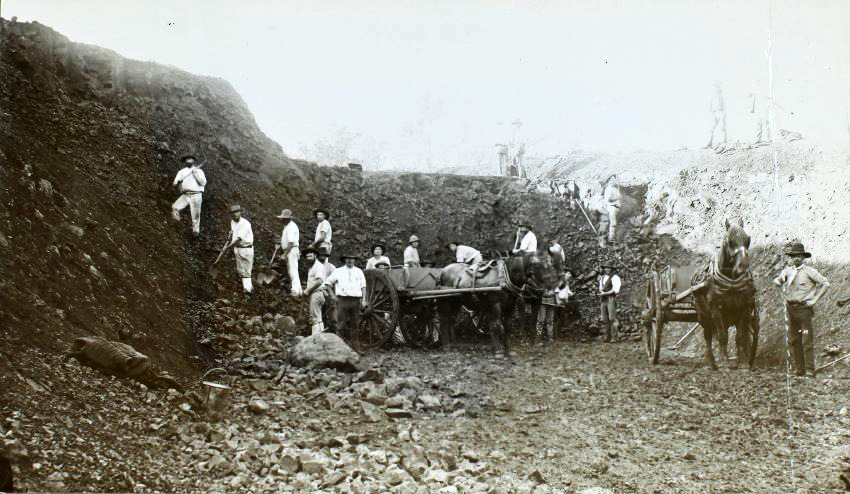
Denis Rowe’s pioneering social history of construction workers in Northern NSW examines in more depth the hitherto neglected itinerant communities that sprang up along the expanding Northern line replete with schools, stores, shanty pubs and small hospitals.40Rowe, ‘The Robust Navvy’. See also Terry Kass, ‘Railway navvies and grog shops 1878–85: promoting law, order and sobriety through Crown Land management’, Journal of the Royal Australian Historical Society, Vol. 110, 2024, pp. 29–48. While I don’t have space to go over these themes in further detail, some schools originating in New England navvy camps continue to operate (for example, Woolbrook, Black Mountain and Ben Lomond Public Schools). It’s also worth noting that larger construction camps such as Ben Lomond (near Glen Innes) or Bolivia (near Tenterfield) quite possibly had populations approaching these established small towns. And despite Armidale’s undoubted status as the New England Tableland’s de facto capital, originally John Whitton planned to bypass it altogether.
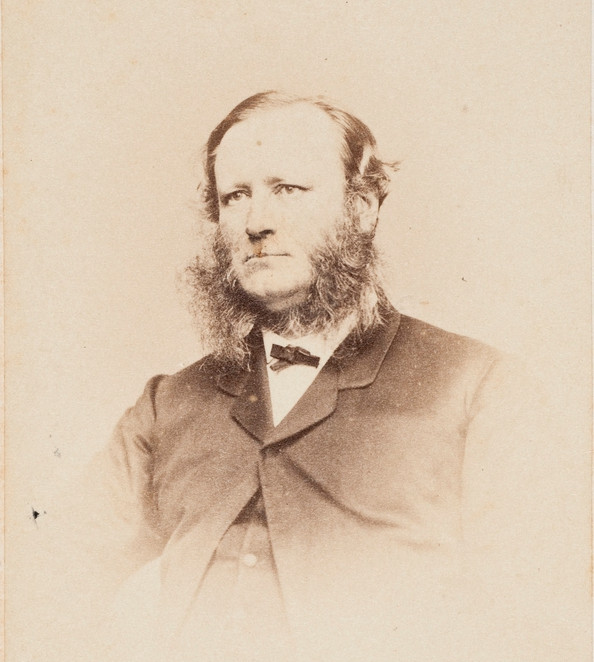
Contention Over the Armidale Station Site
By 1880, Whitton was a singularly influential public servant now remembered as the ‘father’ of railway development in NSW.41See generally Robert Lee, Colonial engineer: John Whitton 1819–1898 and the building of Australia’s railways, Sydney, 2000. Initially, he recommended that the route be generally aligned to the Great Dividing Range westwards of Armidale. This meant that the town’s Railway Station would be situated at Saumarez Ponds, a wheat growing area about eight kilometres west of Armidale and this cheaper option was approved by parliament in 1878. The original station site is (very approximately) noted in yellow on the map below.
While a rural site was of little consequence to local wool or beef producers, it rightly was perceived as a considerable inconvenience for Armidale residents and also had practical implications for the burgeoning town economy, projected property values and so forth. Whitton had bypassed the southern New England town of Walcha in an even more oblivious fashion—by 20 kilometres or so, leading to calls for the construction of a branch line into town soon after railway services commenced (Walcha Road station is also noted on the map above, in red).42Sydney Morning Herald, 21 July 1883, p. 9; 27 September 1883, p. 9. This proposal never was seriously contemplated but the situation was different at the larger and more influential community of Armidale, where lobbying by its former Mayor John Moore, Samuel Terry and others led parliament in April 1880 to approve a deviation to the town’s south western boundary (noted in blue on the map above).43Maitland Mercury, 15 October 1878, p. 2; Armidale Express, 23 June 1879, p. 4; 19 September 1879, p. 4; 3 October 1879, p. 6, 10 October 1879, p. 6 . Terry, then a New England parliamentary representative, vowed never to set foot in Armidale again if he failed to effect the change.44Ferry, ‘Colonial Armidale’, p. 80; Armidale Express, 9 April 1880, p. 6. He was, in any case, resident in Sydney and soon resigned his seat; however, parliament’s change of heart was a significant political victory for Armidale’s urban population and mercantile interests. So keenly was the station relocation sought that spontaneous public celebrations erupted when the news arrived from Sydney.45Armidale Express, 9 April 1880, p. 6. Sydney Morning Herald, 22 April 1880, p. 2. Harman, ‘Politics and railways’, pp. 282, 284.
The new station site was situated near the entry point to town of the Great Northern Road (later the New England Highway, which now bypasses Armidale’s urban area). West Armidale already had a somewhat working-class flavour subsequently amplified by the settlement of a considerable number of railway workers (and which it retains, although railway employment virtually has disappeared). While the Armidale deviation was significantly more expensive than Whitton’s preferred route, the new station site had the advantage of being reasonably close to the town centre without requiring much resumption of improved land.
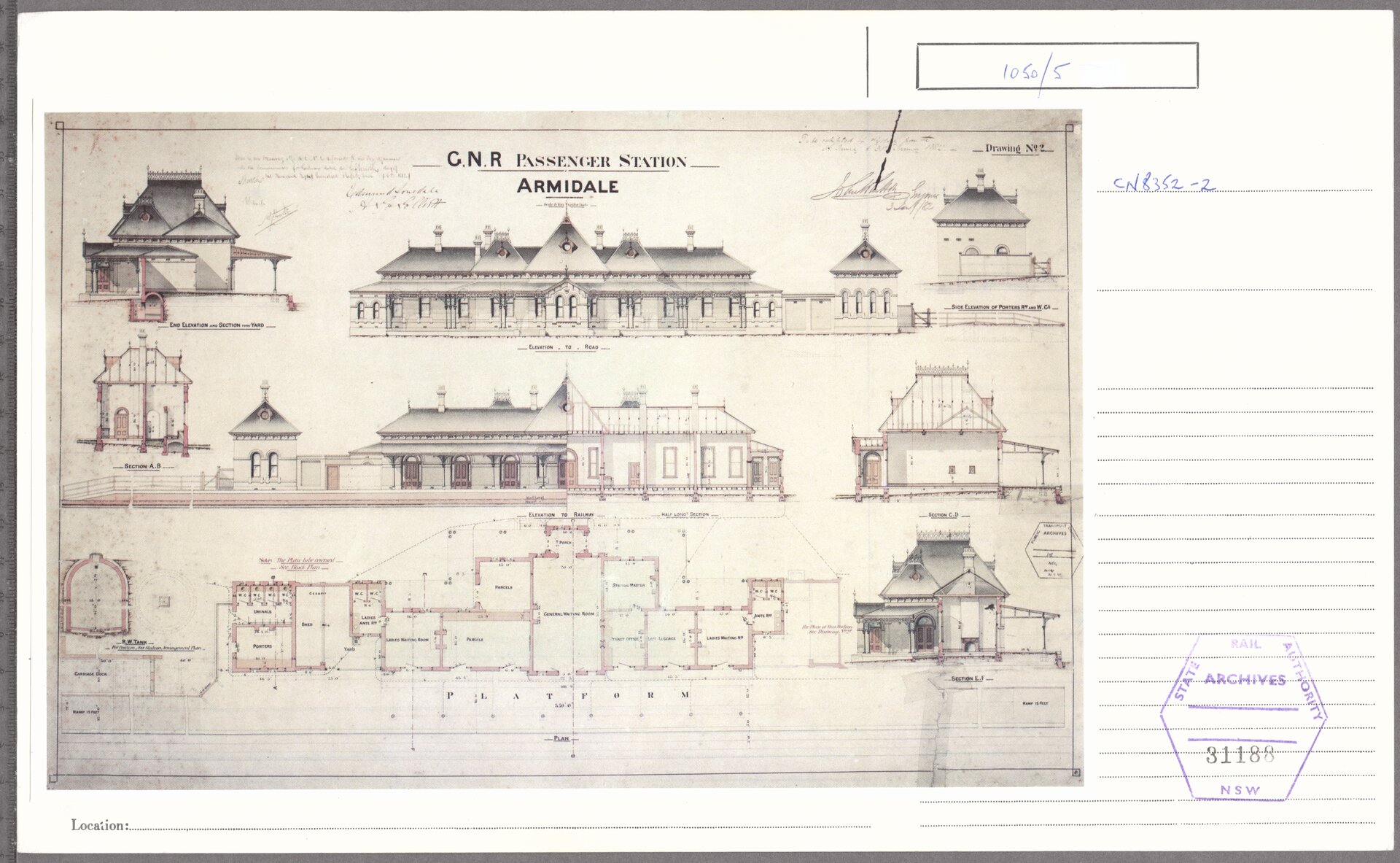
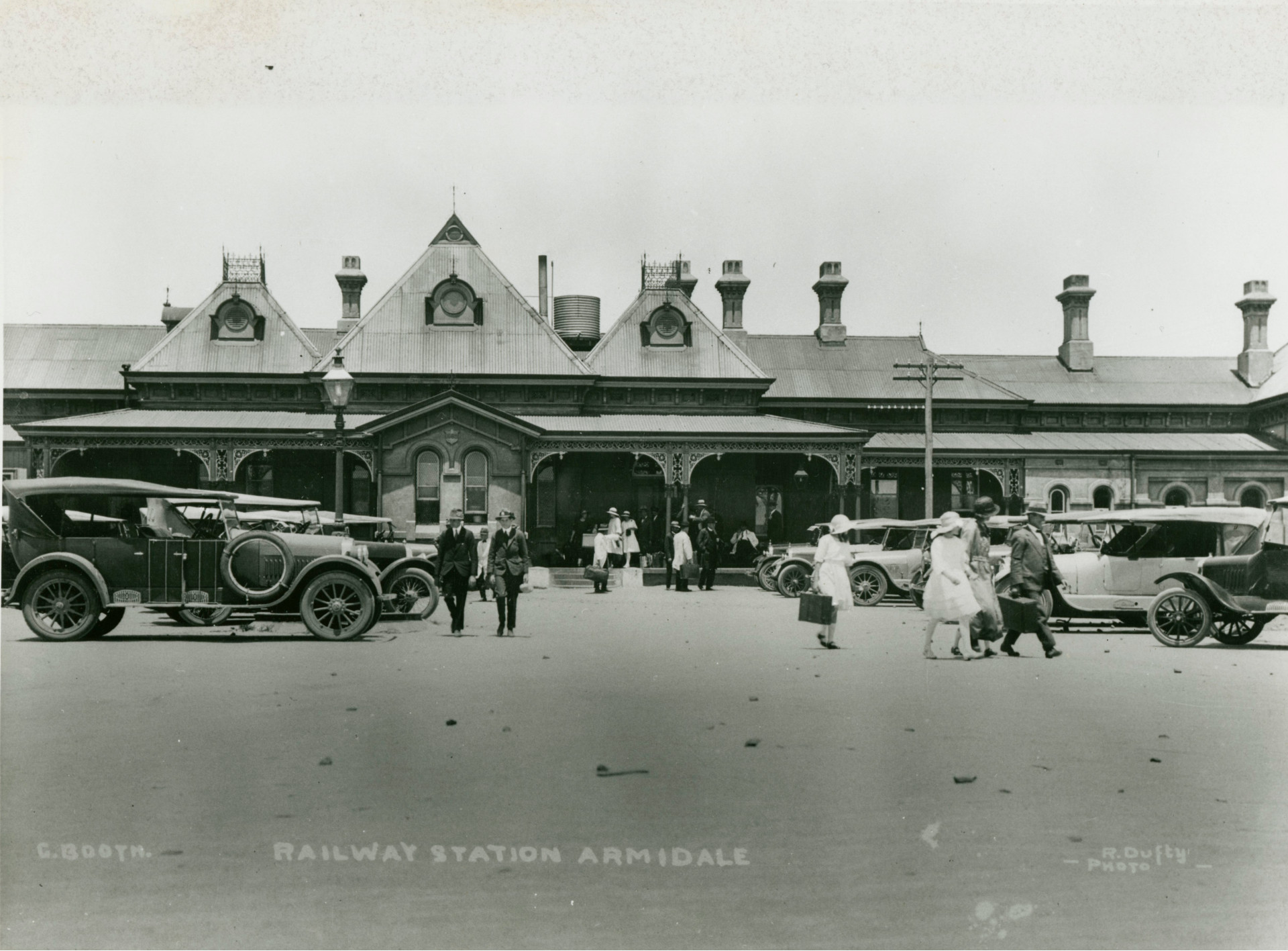
Passenger station size, design, architectural pretension and expenditure were based upon a hierarchy devised by Whitton and his staff to reflect a community’s economic and social significance (current and projected). Terminus stations were also sometimes markedly larger and more ornate than demographics would suggest (Bourke’s original station, opened in 1885 and destroyed by fire in 1965, being a notable example). Once the decision was made to relocate to Armidale, the Station ended up being an impressive and relatively sophisticated building that reflected the town’s regional status. A substantial Goods shed, Engine shed and Station master’s house were also significant features of the original Railway Station precinct.
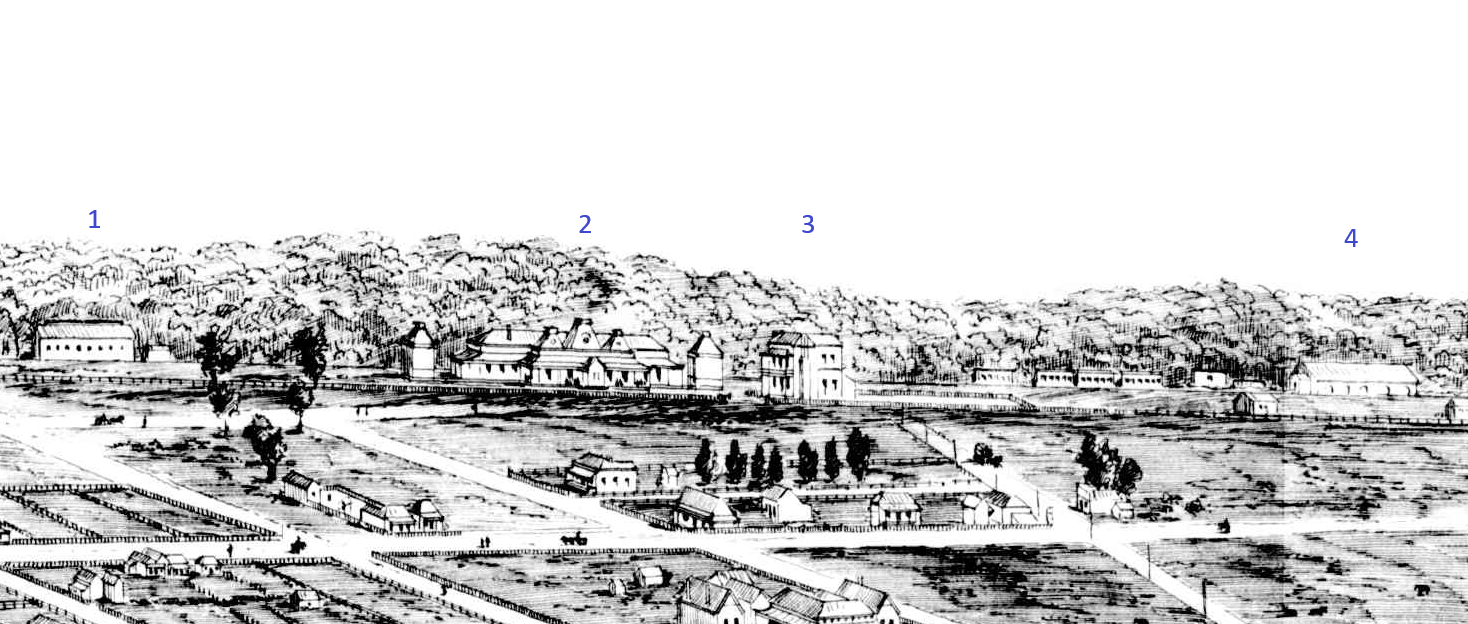
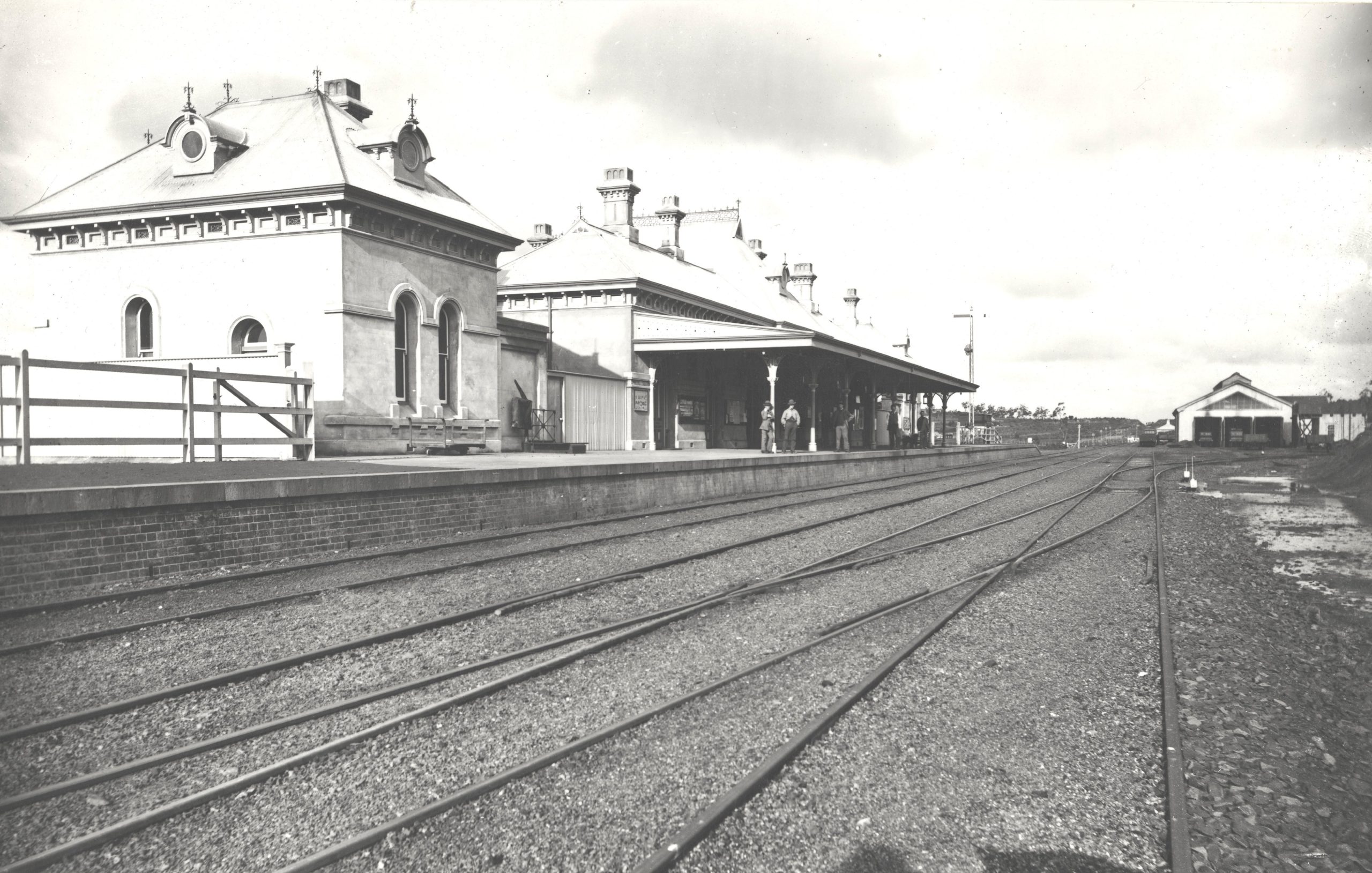
Now listed on the NSW State Heritage Register, Armidale Station survives in well maintained operational condition. The central portion retains some of its original layout and exterior fabric although both ends have been modified (the western extension not particularly sympathetically). Daily NSW Countrylink Xplorer services now terminate at Armidale, the line to the north having been closed for many years, in decay and potential adaptive reuse being subject to heated community debate.46Council-supported proposals to redevelop sections of disused rail corridor for tourist-orientated rail trails have become prominent local political issues in recent years. In 2024, previously secured state and federal funding was withdrawn, leaving rail trail plans in limbo. Rail trail opponents want the closed line reopened.
The 1883 Opening Celebrations
Notwithstanding the strikes, delays, poor weather and accidents during construction, the gala openings of Tamworth, Armidale, Glen Innes and Tenterfield stations generally were perceived as the most important events in these towns’ brief histories. One visitor described the 1883 Armidale celebration as ‘the greatest demonstration I ever witnessed, either in the old country or in the colony’.47Armidale Express, 9 March 1883, p. 4. The Tamworth and Tenterfield openings, however, were the only regional celebrations attended by the NSW Governor. In fact, the absence from Armidale’s opening of both the new NSW Premier (Alexander Stuart) and the ‘stay at home gentleman who represents royalty in New South Wales’ (Lord Augustus Loftus) was perceived as an insult to the entire region.48Uralla and Walcha Times, 7 February 1883, p. 2.
Similar reprimands had been directed at the seat of colonial government in 1882, when Uralla station was opened. No ceremony at all originally had been contemplated for this village about 20 km south of Armidale, close to the location of the first major New England gold rush (Rocky River). Mining having been significantly reduced in the interim, Uralla’s population had fallen to less than 500. Nonetheless, after complaints were made the Attorney-General Robert Wisdom journeyed from Sydney to open the section.49 Uralla and Walcha Times, 9 August 1882, p. 2; Armidale Express, 4 August 1882, p. 4. The Armidale Express, the region’s first newspaper (1856), fumed at the unprepossessing nature of this belated, poorly planned and slightly chaotic ceremony: ‘It is not Uralla alone that felt the slight, but a large and influential district comprising four townships’.50Armidale Express, 28 July 1882, p. 4.
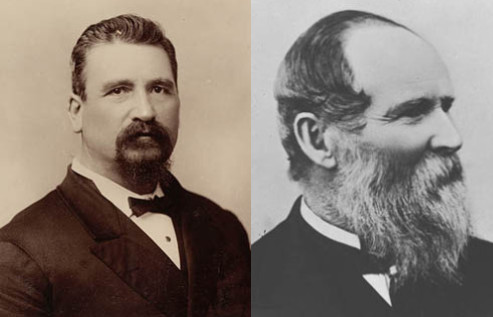
Despite the anger felt locally, when the Armidale extension opened six months later it also had to make do with a Ministerial delegation headed by the Secretary of Public Works, Henry Copeland, and the Secretary for Lands, James Farnell. A ‘fair sprinkling’ of other parliamentarians (about seven by my count)51Bulletin, 10 February 1883, p. 14. attended the opening, free railway passes being issued to all members and parliament having been effectively adjourned for the purpose.52Armidale Express, 2 February 1883, p. 4. ‘Free Passes to Armidale’, Votes and proceedings of the Legislative Assembly, New South Wales, 1883 session, Vol. 2, fols. 505–10. Copeland and Farnell were relatively prominent colonial politicians who did have local connections: Copeland had mining interests at Uralla and had been a member for the Northern Goldfields and then New England; Farnell, a former Premier (1877–78), had just won the latter seat.53C.N. Connolly, Biographical register of the New South Wales parliament, 1856-1901, Canberra, 1983, pp. 63, 102. Like Terry, both men were based in Sydney but absentee representative arrangements for rural electorates then were common.
Contrary to the Armidale Express’s bluster, it’s worth reiterating that the main New England towns remained comparatively small urban communities in the early-to-mid 1880s. In hindsight, the NSW railway system’s quite extensive development by 1885 is astonishing given the colony’s relatively sparsely populated interior—outback or otherwise. In 1881, Armidale’s town population was just under 2,200 while Glen Innes was about half; in fact, the tin mining town of Vegetable Creek (now Emmaville) had a higher population than Armidale.54Sydney Morning Herald, 18 February 1882, p. 3; Clarence and Richmond Examiner, 2 July 1881, p. 6. Modern Emmaville has a district population of about 500. On the other hand, due to closer settlement policies and often relatively short-lived mining booms, the district populations of towns such as Armidale and Glen Innes usually were significantly higher than the urban aggregate. Today the situation is very different at Armidale, where the town far exceeds the surrounding district population.
Uralla excepted, regional railway opening demonstrations generally were carefully planned celebrations. While some necessary liaison between town organisers and the NSW Railways Department occurred, administration largely was dependent on local leadership and participation. At Armidale, both the planning and conduct of various celebrations reflected the class, cultural and gender norms of the late Victorian public sphere. Organisational committees abounded but were supervised by an Executive Committee comprising 13 prominent local men. These included two of the leading factional players in nineteenth-century town politics: the Irish Protestant Tory, John Moore, and the English Catholic John Trim. Both arrived in Armidale very early on—Trim as a convict in the late 1830s. Both also established themselves as storekeepers and became Mayors of Armidale (Moore on numerous occasions).55Ferry, Colonial Armidale, pp. 39, 45; Lionel Gilbert, comp., An Armidale album, Armidale, 1982, p. 110. While sub-committees were set up to plan and manage various Ministerial reception, banquet and ball responsibilities, no women appear to have been appointed to these supervisory bodies. However, an otherwise obscure ‘Ladies Committee’ assisted teachers supervise a ‘Children’s Demonstration’ in the main procession. This was followed by a sports carnival at the racecourse, near the site of the original Crown Land Commissioner’s camp.56Armidale Express, 26 January 1883, p. 5.
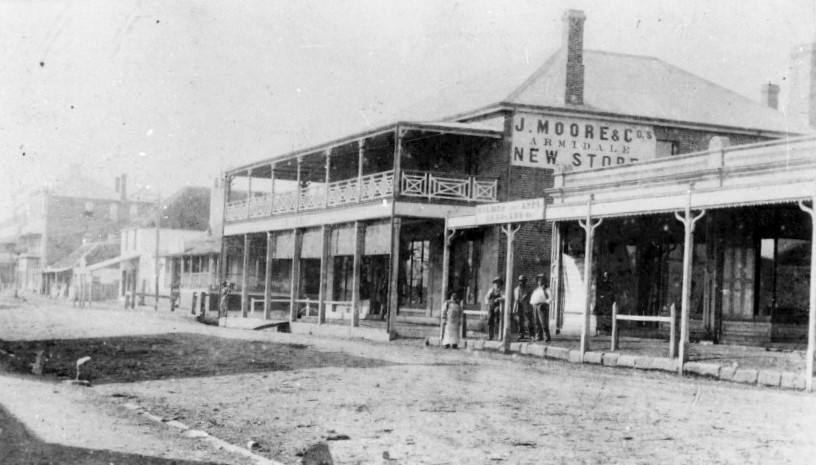
As we saw earlier, the relocation of the station site resulted from concerted lobbying by what might be termed town interests. While Armidale’s working class likely had no input into formal railway opening planning activities, the absence of graziers within the ranks of the Executive Committee is quite surprising and, once again, suggests a general shift away from pastoral influence over local/town affairs by the early 1880s. In fact, I haven’t been able to identify any prominent graziers among the initial membership of the Railway League formed at Armidale in 1867 either. While many pastoralists were members of the opening’s 200-strong ‘General Committee’, its practical role seems to have been negligible, being more of a roll call of prominent residents (pastoral, mercantile, mining and professional) of the wider New England region.57For the membership of various railway demonstration committees see the lists published in the Armidale Express, 26 January 1883 p. 5. A few influential graziers such as F.R. White of Saumarez near Armidale and C.D. Fenwick[e] of Europambela in the Walcha district were on the Reception Committee, as were all of Armidale’s clergymen and aldermen.58Armidale Express, 26 January 1883 p. 5. The more powerful Executive Committee, on the other hand, primarily comprised merchants, town administrators and professionals.
Due to construction delays, the Armidale opening date had to be postponed from late 1882 until early February 1883. John Ferry, in his lauded social history of colonial Armidale thus describes the railway opening as an ‘anti-climax, delayed by two months by bad weather and lack of materials … The railway station was far from complete; the goods station and engine shed were mere skeletons; there were no triumphal arches in the streets; the Governor failed to attend’.59Ferry, Colonial Armidale, p. 84. While this was mostly true, it downplays the very real sense of jubilation felt about the advent of the railway and a range of celebrations that marked an undeniably important civic milestone.
Lord Loftus and Premier Alexander Stuart’s absence meant that the Ministerial delegation was the focus of ceremonies when the official train arrived at about 2 pm on 1 February 1883. This had been declared a regional holiday60Armidale Express, 2 February 1883, p. 4. and, as noted earlier, the Railways Department controversially had made available free passes to parliamentarians and their associates: about 700 people seem to have taken them up although it’s not clear how many travelled to Armidale.61Votes and Proceedings of the Legislative Assembly, NSW, ‘Free Railway Passes to Armidale’. The Sydney Daily Telegraph criticised the effective adjournment of parliament ‘to facilitate a junketing expedition’, noting that Armidale was quite close to recently opened Uralla and not the planned terminus.62Daily Telegraph, 31 January 1883, p. 2. Cheap holiday fares were also offered to the public and the excursion trains that followed the Ministerial train to Armidale were very crowded in the final stages of the journey (‘hellish’, according to one account).63Maitland Mercury, 3 February 1883, p. 3. Echoing numerous mishaps and accidents during the line’s construction, the Ministerial train actually caught fire near Singleton causing ‘great sensation’; however, the affected carriage quickly was replaced.64Australian Town and Country Journal, 3 February 1883, p. 205; 17 February 1883, p. 311.
Armidale is wettest in summer and some rain had fallen beforehand but on opening day the weather cleared and a substantial crowd gathered at the station to witness the arrival of the dignitaries. That said, initial formal ceremonies at the station precinct were surprisingly brief: the official guests were greeted by Mayor John Moore and Henry Copeland declared the line open. An ensign was hoisted, the band played God Save the Queen and three cheers were given by the crowd. In conclusion, ‘some shots were fired from a small piece of ordnance’.65Armidale Express, 2 February 1883, p. 4.
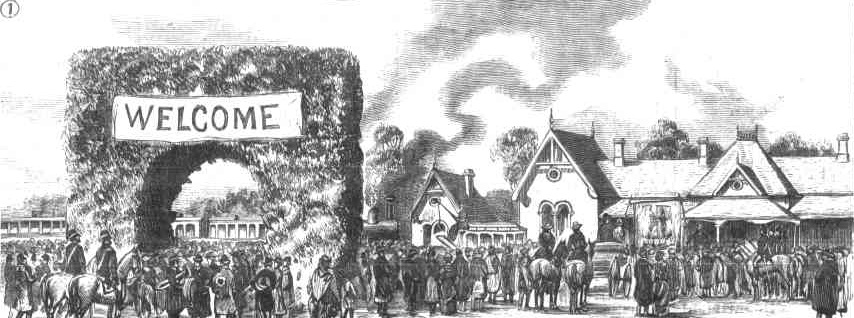
The brevity of celebrations at the station may have been influenced by its embarrassingly incomplete state in February 1883—organisers were forced to use drapes and other decorations to conceal the building’s ruder elements.66Luxton, ‘Edmund Lonsdale’, pp. 88–89. But other factors likely were at play here. The belated opening ceremony at Uralla had resulted in an almost chaotic invasion by the public of the freely accessible railway platform—a space that was tightly policed at Armidale.67Uralla and Walcha Times, 9 August 1882, p. 2; Armidale Express, 4 August 1882, p. 4. Similar crowd control problems had been reported when the first section to East Maitland was opened a quarter of a century earlier.68Maitland Mercury, 31 March 1857, p. 2. While the crowd at the Armidale station opening almost certainly was the largest to gather in town to that point (see below), organisers had no intention of letting them on to the temporarily privileged platform space. About twenty police controlled crowd movements at the station building and the ends of the single platform were ‘barred up’ to prevent entry. The general public thus was forced to congregate along the line and the station approach area immediately north of the passenger building. This meant that the great majority of spectators would not have been able to view the formal line opening ceremony (their vision would have been impeded by the station building and barriers). Members of the General Demonstration Committee, on the other hand, enjoyed unfettered access to the temporarily exclusive platform.69Armidale Express, 2 February 1883, p. 4.
Funded and operated by the state, railway platforms were perceived as spaces akin to public roads and the crowd control arrangements were not to the liking of all: ‘some people were very indignant at not being able to come on the platform’, noted the Express, ‘but it was necessary to be very strict and no exceptions could be made’.70Armidale Express, 2 February 1883, p. 4. So stringently were the Executive Committee’s directives followed in this respect that Edmund Lonsdale, one of the principal contractors engaged in building the passenger station and an Armidale councillor, was also refused entry to the platform.71For Lonsdale see Robert Luxton, ‘Edmund Lonsdale—A Biography’, Armidale and District Historical Society Journal, 29, 1986, pp. 83–98. Despite Lonsdale’s day-to-day co-supervision of the construction site—and despite being a signatory to the formal welcome presented to the Ministerial delegation—when he arrived at the station with a party of women he was not in possession of the appropriate rosette that acted as a pass to the Ministerial reception area on the platform. An altercation ensued between the enraged builder and James Bray, Armidale’s Clerk of Petty Sessions and Executive Committee member, culminating in Lonsdale laying an assault charge against Bray; Lonsdale apparently also attempted to tear down some of the platform barriers during the fracas.72Armidale Express, 9 February 1883, p. 6.
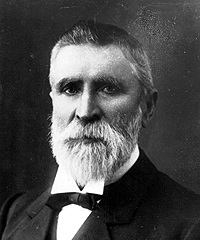
Subsequent court proceedings excited considerable public interest and Bray was found guilty by his senior colleague, the Police Magistrate, and fined ten shillings.73Armidale Express, 9 February 1883, p. 6. However, members of the public at the hearing immediately furnished the penalty and costs as a mark of support.74Armidale Express, 9 February 1883, p. 6. Nor does Bray’s conviction appear to have hindered his employment prospects: within months, in fact, he was promoted to the position of Police Magistrate at Casino. Just before leaving Armidale, Bray was presented with £125—a much more substantial sum than that tendered in the aftermath of his assault conviction—by supporters and friends, including the town’s Chinese community.75Maitland Mercury, 31 July 1883, p. 6. Lonsdale and his partner Henry Elliott, on the other hand, were sinking into insolvency—the troubled Armidale Railway Station construction contract being primarily responsible for their travails.76Luxton, ‘Edmund Lonsdale’, p. 90. Nonetheless, Lonsdale became one of the New England region’s first professional politicians, being returned on a number of occasions to the NSW Legislative Assembly and also the federal House of Representatives. Terribly injured when hit by a motor taxi near Uralla Police station in October 1913, Lonsdale died the same evening while being transported to Armidale Hospital on a freight train.77Armidale Chronicle, 8 October 1913, p. 3; Sydney Morning Herald, 7 October 1913, p. 9.
Not surprisingly, Ministerial dignitaries were given pride of place in the procession to the centre of town that followed the formal declaration of the opening of the line. Reportedly, it was about half a mile (800 metres) long and organised by police and three marshals (including John Trim, probably by virtue of his standing among the Catholic portion of the town population).78Armidale Express, 2 February 1883, p. 4. Mounted police and the Lambton band (which had travelled from Newcastle to enliven proceedings) led the procession while the Mayor and Ministerial guests, as well as prominent local residents followed. Marching behind in regalia were members of various local friendly societies (Odd Fellows, the Order of Foresters, the Sons of Temperance and others) and the Armidale band. At the rear were the rest of the crowd. After half an hour’s marching the procession terminated at a speaking platform erected off Rusden Street, near the Church of England cathedral.79Armidale Express, 2 February 1883, p. 4.
The relatively short distance between the station and central Armidale (about 1.6 km by road) meant that a somewhat more extended route needed to be taken by the procession as it was perceived as a chance to showcase Armidale’s central streetscape: ‘it was not thought right that our visitors to our city should be allowed to escape a glimpse of Beardy-street’, noted the Express, and hence the inclusion of Armidale’s main street despite it not being on the direct route to the hustings.80Armidale Express, 2 February 1883, p. 4. However, as John Ferry remarks, triumphal arches along the procession route were ‘conspicuous by their absence’: ‘the Committee had not the funds at their disposal’, lamented the Express, ‘and they wisely, at an early stage, abandoned all ideas of triumphal arches’.81Ferry, Colonial Armidale, p. 84; Armidale Express, 2 February 1883, p. 4. That said, construction contractors David Proudfoot or Edmund Lonsdale appear to have provided a lone arch at the approach to the station. In the absence of funds for more complex decorations, timber poles were erected at street intersections with lines carrying ‘innumerable flags’. Private residences along the procession route also were decorated with bunting and other symbolic devices.82Armidale Express, 2 February 1883, p. 4.
Formal outdoor celebrations concluded after appropriate addresses were made by Mayor Moore and the visiting ministers. The Railway Demonstration Committee membership was then able to continue festivities in more exclusive convivial surrounds than the open land which now forms Armidale’s Central Park. Although some women appear to have been admitted to the railway platform to witness the formal opening of the line and were prominent upon the speaking platform erected off Rusden Street, they were excluded from the railway opening banquet held at Armidale’s nearby new Town Hall. Class hegemony (and the expensive ticket price of one guinea, about A$150 today) likely helped ensure that few (if any) working men were in attendance at this gathering of about 300 prominent New Englanders, NSW parliamentarians and their guests. Despite the exclusivity of the banquet in terms of class and gender, something of an uproar occurred when James Farnell defied the convention of impartiality generally adhered to on festive occasions by abusing the erstwhile colonial administration of Sir Henry Parkes and another notable former Premier, Sir John Robertson.83Newcastle Morning Herald, 2 February 1883, p. 2. As noted earlier, Farnell had just become a member for New England; he had also once been an ally of Parkes but his intemperate denunciation of the colony’s two most prominent politicians was greeted with ‘confusion’, loud groans ‘and shouts of “Sit down”’.84Newcastle Morning Herald, 2 February 1883, p. 2.
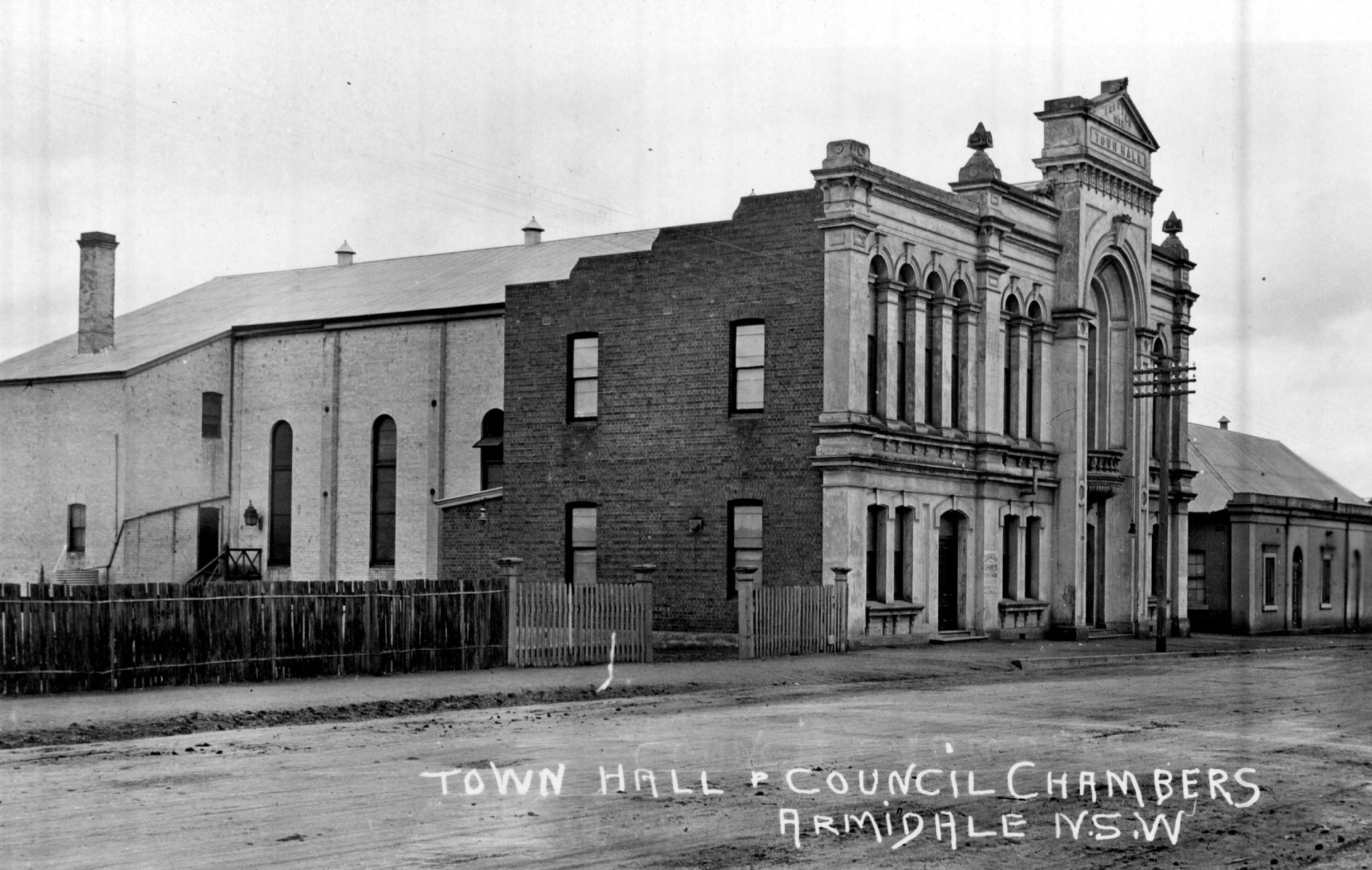
Later in the evening a fancy-dress ball, hosted by Mayor John Moore, was also held at the Town Hall. Women, of course, were admitted to the subscription balls held on successive nights at the Town Hall—another significant physical component of Armidale’s escalating civic identity. Once again, however, considerable improvisation was necessitated by this building’s equally incomplete state: although the walls had ‘been built to their full height’, the Town Hall lacked permanent flooring or even a roof at this time!85Armidale Express, 26 January 1883, p. 6, 2 February 1883, p. 4. As the Bulletin commented: the ‘roofless skeleton looked very unlike a place where any ball could be held’.86Bulletin, 10 February 1883, p. 14. Nonetheless, drapes again hid incomplete sections and a large tarpaulin protected guests from falling rain.87Bulletin, 10 February 1883, p. 14. Remarkably, the food and drink made available for the successive functions/balls at Armidale was imported from Sydney by sea and rail.88Bulletin, 10 February 1883, p. 14. As Henry Copeland explained: ‘everything, the glass, the crockery, the eatables, and drinkables … was all brought from Sydney’.89Armidale Express, 2 February 1883, p. 4. While the unfinished state of the new Town Hall likely necessitated this surprising catering arrangement, it would be a considerable organisational achievement today—let alone in 1883.
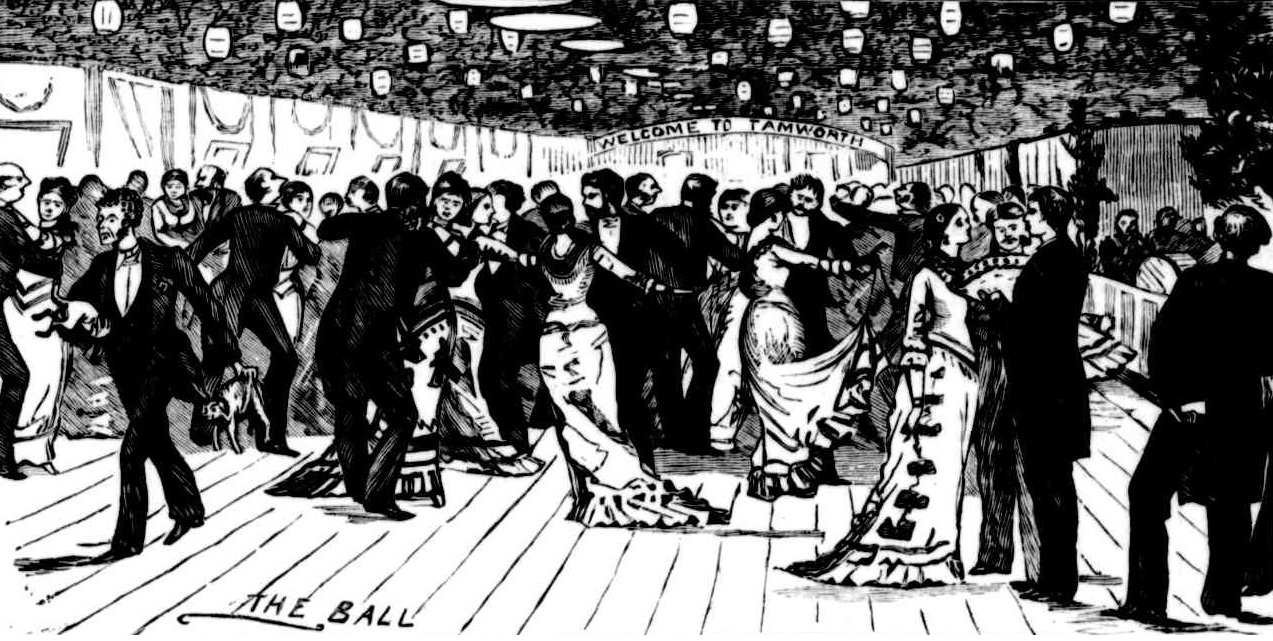
The question of public access to indoor railway opening celebrations had been raised by an Armidale Express correspondent some months earlier.90Armidale Express, 17 November 1882, p. 1. This writer allowed that the proposed Mayor’s Fancy Dress ball would be ‘by necessity, by invitation’, while the second ball on the following night should be open to all. ‘The town has been, unhappily, divided for some time but it is fervently to be hoped that on this auspicious occasion the hatchet should be buried … in my opinion, this can only be accomplished by making the whole of the festivities in connection with the opening of the railway to Armidale as public as possible’.91Armidale Express, 17 November 1882, p. 1. The discord alluded to here likely emanated from sectarian dispute which had characterised Armidale’s local politics and public life since the 1860s—and in which John Moore was a prominent antagonist.92Ferry, Colonial Armidale, pp. 187–91. More generally, see Frank Bongiorno, ‘Electioneering in New England 1856–1889, Journal of the Royal Australian Historical Society, Vol. 93, 2007, pp. 133–51. Despite rough beginnings as a frontier outpost, perceptions of Armidale as a hive of late Victorian respectability plainly were evident by the early 1880s, when the small town was assuming the title of a ‘Cathedral City’ (the Roman Catholic and English Churches having both chosen it for regional ecclesiastical administration). In late 1883, for example, a visiting Town and Country Journal reporter claimed: ‘everything about the place is pervaded by an unmistakeable air of the highest respectibility’.93Australian Town and Country Journal, 17 November 1883, p. 933. The arrival of the railway, in turn, helped spur Armidale’s claims for formal recognition as a state-proclaimed ‘city’, which eventuated in 1885.94Heather Burke, Meaning and ideology in historical archaeology: style, social identity, and capitalism in an Australian town, New York, 1999, pp. 194–95.
In addition to cheap excursion tickets offered by the Railways Department to entice visitors to Armidale, a public holiday was proclaimed for Tamworth, Armidale and neighbouring New England communities.95Armidale Express, 26 January 1883, p. 6. When Uralla station was opened in 1882, the Express claimed that 3–4,000 spectators were present.96Armidale Express, 4 August 1882, p. 4. If this figure was accurate, Uralla’s normal population temporarily had swollen by a factor of ten (and, likely, some form of crowd control would have been prudent). At Armidale, it was estimated that between 3,000 and 8,000 people were at the Station when the Ministerial train arrived.97Armidale Express, 2 February 1883, p. 4. Daily Telegraph, 3 February 1883, p. 7. Sydney Mail, 3 February 1883, p. 232. As we saw earlier, even the lesser figure was in excess of Armidale’s urban population (2,187 in 1881).98Sydney Morning Herald, 18 February 1882, p. 3. Although divergent crowd estimates should be treated with caution, it’s clear that accommodation facilities were stretched to the limit by the influx of visitors. To help alleviate the situation, the state provided large tents for male visitors; rail carriages were also used for temporary sleeping accommodation.99Evening News, 29 January 1883, p. 2; Armidale Express, 30 January 1883, p. 1; Australian Town and Country Journal, 17 February 1883, p. 311. In hotels, nonetheless, men were forced to sleep on tables and floors due to a lack of beds.100Australian Town and Country Journal, 17 February 1883, p. 311.
I’ve argued that the great majority of Armidale’s residents would not have been able to witness the formal opening of the line, attend the opening banquet, or attend the Town Hall balls. Yet perhaps not many working people cared about balls or banquets as a range of traditional popular entertainments beckoned elsewhere. ‘Business has been practically suspended’ about town, noted the Express, here referring to the circuses, bands, travelling musicians and ‘peripatetic strangers’ who were prominent during the opening week.101Armidale Express, 2 February 1883, p. 4. Public attractions included performances by Ashton Junior’s Circus, Lily Marsh’s Comedy and Burlesque Company and South’s English and American Opera Company.102Armidale Express, 23 January 1883, p. 1; 30 January 1883, p. 1; 9 February 1883, p. 4. The latter explicitly advertised their arrival as a consequence of the railway.103Armidale Express, 23 January 1883, p. 1. Street performers included an acrobat named ‘Young Collings’—‘The Great Australian Blondin’.104Armidale Express, 19 January 1883, p. 6. Charles Blondin, of course, was the French acrobat and tightrope performer famous for crossing the Niagara Falls (and a number of Australian tightrope performers cultivated this type of association in the 1880s). An acrobatic feat of another kind took place in the pages of a prominent colonial newspaper.
A Clairvoyant Reporter
Like many of its contemporaries, the Newcastle Morning Herald published a report of the Armidale railway opening demonstration. Celebrations of this nature tended to follow established protocols and newspaper accounts tended to be similar as well:
Armidale; Thursday Evening.— The official opening of the extension of the Great Northern Line from Uralla to Armidale — a distance of fifteen miles — took place at noon to-day, in the presence of an immense crowd, who came into town from the surrounding districts in hundreds. On Monday, Tuesday, and Wednesday evenings the special trains which left Newcastle at 6.45 a.m. arrived at the terminus about 7.30 p.m., and each added large numbers to the crowds already here. There were fully two thousand visitors from the Newcastle and Maitland districts, and the scrambling which took place for accommodation was amusing to witness. Many old stagers — accustomed by experience to similar rushes — came prepared for any emergency, and brought tents, hammocks, provisions &c., in abundance … The weather was delightful all the week, and the surrounding country looks glorious. As the Ministerial train drew up to the station between 1 and 2 o’clock today, there was a tremendous crowd to welcome it, and the band struck up an inspiring air, amidst deafening cheers from those assembled. Representatives from each of the Friendly Societies in Armidale presented neatly presented addresses to the Ministry, who made appropriate replies to each.105Newcastle Morning Herald, 31 January 1883, p. 3.
There was little wrong with this—apart from the fact that it was published the day before the Armidale opening took place. ‘How is that for reporting!’, exclaimed a bemused editor of the Uralla and Walcha Times.106Uralla and Walcha Times, 7 February 1883, p. 2. Again, however, there were few errors in the imagined account, a telling pointer of the formulaic character of railway opening ceremonies and their mediation in the colonial press.
Unabashed, the Herald immediately published a parody of the premature piece—authored by a ‘Clairvoyant Reporter’—which also diverged from custom by lashing out at the ‘army of carpetbaggers and professional spongers’ who ventured to the ‘classic regions of Armidale’.107Newcastle Morning Herald, 1 February 1883, p. 3. So soon was this piece composed that it also may have appeared in print prior to the formal opening (as its title states, the Herald was a morning paper). The following day, a conventional account of the actual opening finally appeared.108Newcastle Morning Herald, 2 February 1883, p. 2. Not surprisingly, none of these ‘reports’ mentioned that the paper’s editor and a reporter had been given free rail tickets to Armidale.109Votes and Proceedings of the Legislative Assembly, NSW, ‘Free Railway Passes to Armidale’, fol. 508. Derogatory opinions of the Armidale celebrations were also aired in the Tamworth Observer, another recipient of government largesse, which opined that the opening ball ‘would have been nothing without the Tamworth people’ who had visited Armidale for the occasion.110Votes and Proceedings of the Legislative Assembly, NSW, ‘Free Railway Passes to Armidale’, fol. 509. ‘The Mayor’s Ball was well patronised’, the paper admitted, but ‘it was not carried out as it might have been … the Mayor seemed to be wrapped up entirely in himself and the few people of his own class, so that the Mayor’s ball was much like the Mayor’.111Tamworth Observer, 3 February 1883, p. 2. Previously, the paper had alluded to the ‘stuck up, “cliqueish” views’ of Armidale’s townspeople.112Tamworth Observer, 31 January 1883, p. 2. Some regional rivalries, it would seem, have long histories.
The Armidale railway opening celebrations were thus redolent of the class-based social and patriarchal gender norms of the late-Victorian era. Despite the considerable level of planning evident at the local level, various factors necessitated almost comic levels of improvisation during formal ceremonies. In fact, the station building was not completed until September 1883—seven months after the (delayed) opening took place.113Armidale Express, 18 September 1883, p. 2. At least two commercial photographers, Andrew Cunningham and Herbert Solomons were then operating in Armidale; somewhat surprisingly, there don’t appear to be any surviving photographs associated with the town’s railway opening (at least in the public domain or archival repositories). Similarly, no engraved images of the Railway Station, Town Hall or the opening demonstration were included in the selection of prominent Armidale buildings published in the Australian Town and Country Journal soon after the line opening.114Australian Town and Country Journal, 10 February 1883, p. 264. Of course, the former omissions likely were influenced by the two buildings’ incomplete state in early 1883; however, the lack of visual representation of anything to do with the Armidale railway opening festivities does seem at odds with reporting of the earlier Tamworth and later Glen Innes openings.115See Australian Town and Country Journal, 26 October 1878, pp. 792-793. Illustrated Sydney News, 2 November 1878, pp. 1, 6. Sydney Mail, 30 August 1884, p. 417.
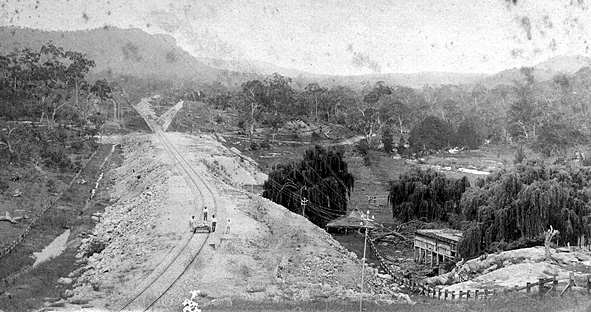
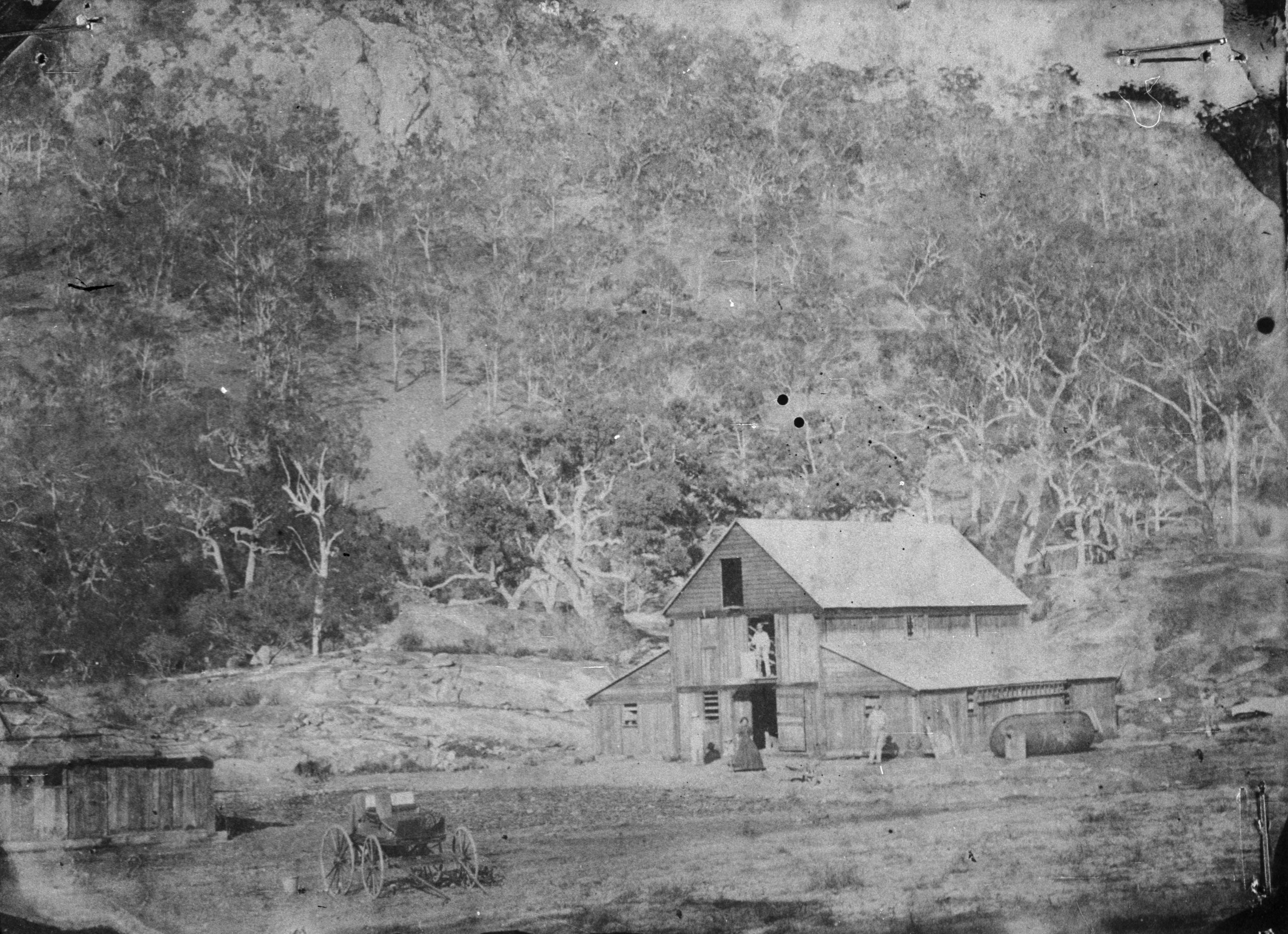
Typically, an essay of this nature would end by noting the social and economic impact of the advent of the railway at Armidale. I’m going to take a different course below but things did change. The Great Northern Railway continued to progress towards the border and New England’s residents and visitors took advantage of improved travelling and freight times. So too did politicians such as Henry Parkes, John and William Redmond (Irish Home Rule advocates) and, later, touring English cricketers and Henry George, the famous United States reformer.116Armidale Express, 23 February 1883, p. 6; 4 May 1883, p. 6; 3 March 1885, p. 2; Glen Innes Examiner, 3 June 1890, p. 2. A building boom initiated by the confirmation of the Tablelands railway route continued and Armidale’s population doubled within a decade or so. On the other other hand, the arrival of railway freight is said to have spelt the end of the fledgling Tablelands wheat and milling industry (cheaper and better quality grain now could be imported).117R.B. Walker, ‘Flour Milling in New England’, Armidale and District Historical Society Journal and Proceedings, Vol. 9, 1966, pp. 3-8. In a precursor of this decline, the Champion flour mill located at Bluff River south of Tenterfield was destroyed by line construction blasting and other operations in the mid 1880s (see photos below and earlier in this essay).118See Warwick Pearson, ‘Water-powered Flourmilling on the New England Tablelands of New South Wales’, Australasian Historical Archaeology, Vol. 16, 1998, pp. 30–44, especially pp. 36–38.
Epilogue: the Death of Jeremiah O’Mullane
While the circumstances behind the Newcastle Morning Herald’s strange coverage of the Armidale opening are now likely beyond the historian’s grasp, a potentially scandalous tragedy which unfolded at sea during the parliamentary party’s transit to New England received comparatively little attention in the colonial press. Most of the attention that did occur, moreover, was in the Herald. As explained earlier, in 1883 there was no direct rail link between Sydney and Newcastle so the Ministerial party and other visitors from the capital had to travel by sea to Newcastle to begin their rail journey to Armidale. On this occasion, many visitors made the six-hour voyage upon the steamer Maitland and, south of Newcastle just after midnight, a passenger named Jeremiah O’Mullane fell overboard and was lost at sea.119Newcastle Morning Herald, 2 February 1883, p. 2.
One extended account of the Armidale opening celebrations that did mention O’Mullane’s demise was written by an anonymous woman using the pen name ‘WAIF’ in the Australian Town and Country Journal a few weeks later.120Australian Town and Country Journal, 17 February 1883, pp. 311–12. See also Evening News, 21 February 1883, p. 6. Waif happened to be on board the second-class carriage that caught fire near Singleton; there’s also a (slight) possibility that she was Irish-born Mary Fortune (c. 1833–1910), a prolific but somewhat mysterious author who typically used the nom de plume ‘Waif Wander’ in press articles, and who now is regarded as a female pioneer of the crime fiction genre.121Australian Town and Country Journal, 17 February 1883, pp. 311–12. See also Lucy Sussex and Megan Brown, Outrageous fortunes: the adventures of Mary Fortune, crime-writer, and her criminal son George, Melbourne, 2025. In any case, Waif and her companion had stayed up late on the Maitland’s deck to avoid the ladies’ cabin—‘What a horrible invention! Imagine about 30 ladies, most of them victims to mal-de-mer, all cooped together.’122Australian Town and Country Journal, 17 February 1883, pp. 311-12. However, they seem to have retired prior to a sea-sick Jeremiah O’Mullane falling overboard off Redhead after midnight. Waif mentioned learning of the loss of a passenger while recounting the rush, at 2:45 a.m, for seats on the Ministerial train; but she didn’t dwell upon O’Mullane’s loss—or the fact that the Maitland’s captain apparently made no effort to stop and search for him.123Australian Town and Country Journal, 17 February 1883, pp. 311-12. Did the presence of the Ministerial and parliamentary party and their need to arrive at far-flung Armidale on time play any part in this decision?
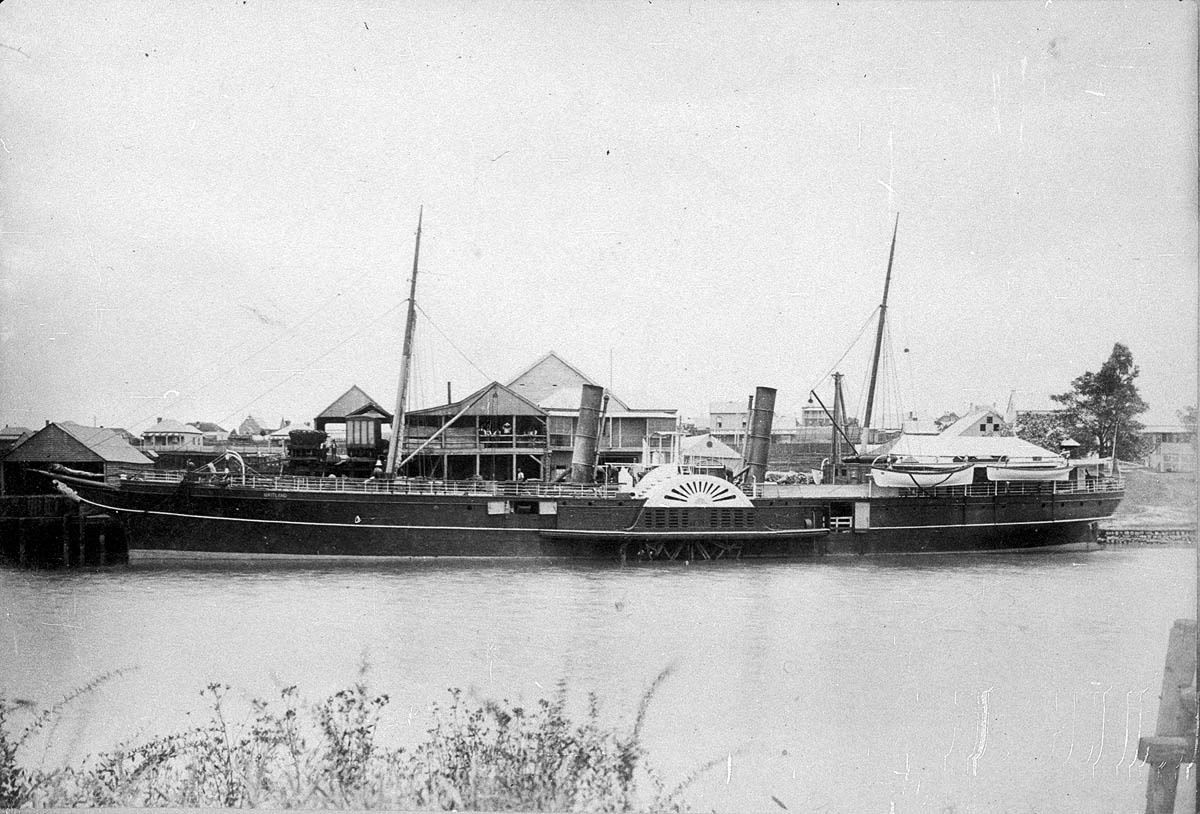
O’Mullane’s death did spur correspondence to the Newcastle Morning Herald calling for better safety provisions upon coastal shipping.124Newcastle Morning Herald, 6 February 1883, p. 3. That said, the paper’s initial report sought to justify the captain’s actions: O’Mullane was thought to have fallen directly into the path of the steamer’s paddle; it was (on this account) very dark and the Maitland had travelled some distance at cruising speed before Captain Knowles ascertained for certain that a passenger had been lost. It ‘would have been sheer nonsense to to have turned back after the delay’, the writer concluded.125Newcastle Morning Herald, 2 February 1883, p. 2. On the other hand, another correspondent reminded readers that in 1880 a crewman who had fallen overboard from the SS Kembla had been rescued, in part due to his captain’s prompt actions.126Newcastle Morning Herald, 9 February 1883, p. 2. The correspondent most critical of the Maitland’s captain was Archibald Gilchrist, a Presbyterian minister who later became the head of the church in NSW. Gilchrist was also a passenger and, unlike Waif and her friend, was present on deck as events unfolded.
Gilchrist did not see Mullane fall; however, seated near the paddle box, he observed the crew’s belated reaction. ‘It’s an awful thing to die’, he wrote, but it was particularly appalling that in this case a man ‘was left to perish without a single effort being made for his deliverance’.127Newcastle Morning Herald, 6 February 1883, p. 3. According to Gilchrist, there was some moonlight and the water was relatively calm:
Between twelve and one o’clock the look-out man gave the cry, ‘A man overboard.’ The cry was uttered in a half hesitating tone, but was repeated several times. The captain came down from his bridge, looked at the engines for an instant as if in doubt what to do, and then ran forward to make enquiries! He stayed there about ten minutes, talking with the look-out man and some passengers, who were smoking as if nothing had occurred. … The man was seen to go overboard; the sea was smooth … An alarm was given, and repeated several times, and yet the steamer holds on her way without even the order to ‘stand by below’ being given.128Newcastle Morning Herald, 6 February 1883, p. 3.
Gilchrist concluded his letter calling for an inquiry to be made into the case; however, no official consideration or review seems to have taken place.129Newcastle Morning Herald, 6 February 1883, p. 3.
An earlier report of the incident in the Town and Country Journal stated that O’Mullane, a Pillaga selector and his family had steerage tickets and that he allegedly was ‘intoxicated, and overbalanced himself as he leaned over the side’.130Australian Town and Country Journal, 3 February 1883, p. 202. ‘As the night was very dark, and the vessel was going at the rate of 12 knots … the captain considered it useless to go back’.131Australian Town and Country Journal, 3 February 1883, p. 202. On this account, ‘the passengers expressed their opinion to the captain (who was greatly concerned) that it would be useless to search for the body’.132Australian Town and Country Journal, 3 February 1883, p. 202. The identity of those who gave this callous counsel was not revealed; however, it would seem extraordinary for a ship’s captain to act in this manner unless they were politically powerful (or otherwise influential). Overall, this incident seems to suggest that political considerations relating to the Armidale opening took precedence over long established nautical conventions. And while Waif may have found the Ladies’ Cabin unpleasant, the scene in steerage, where O’Mullane’s wife and daughter screamed and moaned in grief, likely was worse.133Australian Town and Country Journal, 3 February 1883, p. 202.
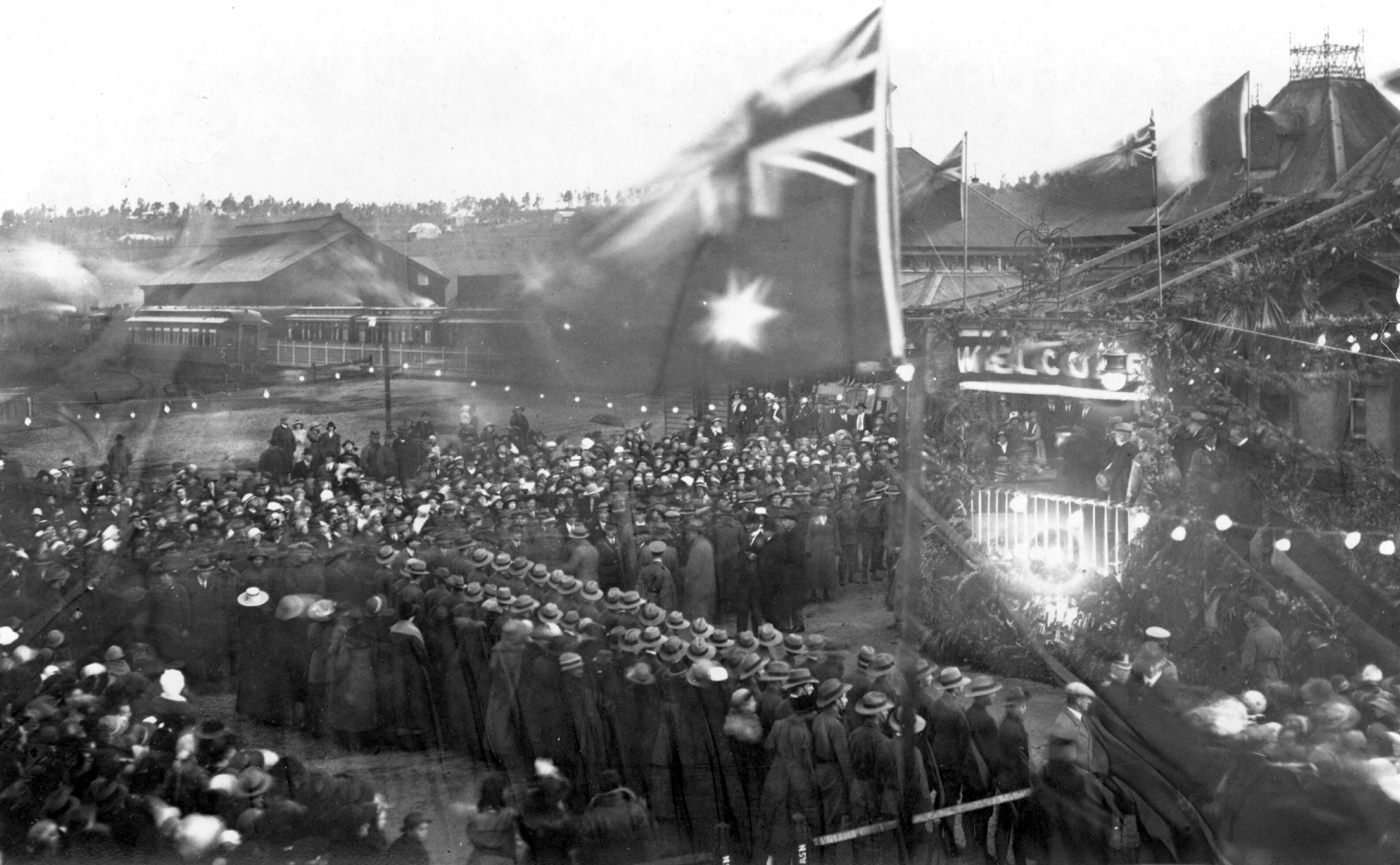
The Armidale railway opening is thus a story of burgeoning civic pretension and pride, drastic improvisation, social exclusion, curious mediation and a potentially scandalous tragedy. Despite the unprecedented celebration and crowds that accompanied the coming of the railway, primary sources sometimes betray a feeling of political neglect and disappointment. A sense of grievance with distant metropolitan power centres certainly grew over time—particularly after regional districts were considered but passed over as potential sites for the new Federal capital of Australia.134The primary New England district considered for the Federal capital was Gostwyck, south of Armidale. In fact, a very similar sense of grievance fuelled the seperatist (but loyalist and sometimes reactionary) Northern New State agitation which became prominent regionally in the inter-war years. Although the Northern New State movement has faded into obscurity, the conservative state government’s 1989 closure of passenger railway services to Armidale, amid similar cuts and large job losses statewide, led to considerable local community protest resulting in their re-establishment in 1993.135Sydney Morning Herald, 31 August 1993, p. 3. Threatened closure a decade later—this time by a similarly neo-liberal Labor administration—spurred another protest meeting at the station, the same place where Armidale residents had gathered for the opening demonstration in 1883.136Sydney Morning Herald, 24 October 2003, p. 3.
© 2026, Andrew Messner. All rights reserved.
Endnotes
- 1For general studies of railway development in NSW see Robert Lee, The greatest public work: the New South Wales railways, 1848–1889, Sydney, 1988; John Gunn, Along parallel lines: a history of the railways of New South Wales 1850–1986, Carlton, 1989; David Burke, Making the railways, Sydney, 1995. ↩︎
- 2See, for example, Mark Hearn, Working lives: a history of the Australian Railways Union (NSW Branch), Sydney, 1990; Lucy Taksa, ‘Technology, Work, Gender and Citizenship at the Eveleigh Railway Workshops Precinct’, Labour History, Vol. 76, 1999, pp. 153–62; Joseph Stark, ‘The Australian Railways Union and Rank and File Democracy in New South Wales, 1925–60’, Labour History, Vol. 128, 2025, pp. 109–30. ↩︎
- 3David Burke, Great steam trains of Australia, Adelaide, 1978; Jim Revitt, The magic of steam: a guide to steam trains working in Australia, Sydney, 1992; Tim Fischer, Steam Australia: locomotives that galvanised the nation, Canberra, 2018. ↩︎
- 4See, for example, publications of the Australian Railway History Historical Society (NSW Division). ↩︎
- 5The situation is somewhat different internationally: see various approaches in Harold Perkin, The age of the railway, London, 1970; Jeffrey Richards and John M. MacKenzie, The railway station: a social history, Oxford, 1986; Nicholas Faith, The world the railways made, London, 1990; Michael Freeman, Railways and the Victorian imagination, New Haven, 1999. ↩︎
- 6For typical examples see railway opening reports in the Maitland Mercury, 31 March 1857, p. 2 (Maitland), Goulburn Herald, 22 May 1869, p. 4 (Goulburn); Ovens and Murray Advertiser, 30 September 1876, p. 4 (Beechworth); compare Northern Daily Leader, 1 February 2022 (a modern newspaper account of the Tamworth opening in 1878). ↩︎
- 7Australian Bureau of Statistics, Armidale Quickstats, 2021 Australian Census. ↩︎
- 8For Aboriginal occupation see Luke Godwin, ‘Inside information: settlement and alliance in the late Holocene of Northeastern New South Wales’, PhD thesis, University of New England, 1990; for the frontier era see Callum Clayton-Dixon, Surviving New England: a history of Aboriginal resistance; resilience through the first forty years of the colonial apocalypse, Armidale, 2020. ↩︎
- 9For Armidale see John Ferry, Colonial Armidale, St Lucia, 1999. More generally, see R.B. Walker, Old New England: a history of the Northern Tablelands, 1818–1900, Sydney 1966 and various essays in Alan Atkinson et al., High lean country: land, people and memory in New England, Sydney, 2006. ↩︎
- 10On regional understandings see Alan Atkinson, ‘What is New England’ in Atkinson et al., High lean country, ch. 1. ↩︎
- 11See generally Alan Atkinson and John Atchison, ‘Travelling and Communicating’ in Atkinson et al., High lean country, ch. 18; Rex Glencross Grant, ‘Dray to steamer: road transport connections between coast and Tablelands in Northern NSW’, Australian Journal of Multi-Disciplinary Engineering, Vol. 7, 2009, pp. 129-36. ↩︎
- 12Armidale Express, 9 November 1861, p. 2. A time ball for public information was installed at the Courthouse when the telegraph arrived. Armidale Express, 16 November 1861, p. 2; 23 November 1861, p. 2. ↩︎
- 13Armidale Express, 21 September 1867, p. 2; Grant Harman, ‘Politics and Railway Development in New England’, Journal of the Royal Australian Historical Society, Vol. 56, Pt 4, 1970, pp. 281–95. ↩︎
- 14
- 15See Gunn, Along Parallel Lines, chs. 4–5; Harman, ‘Politics and Railway Development’. ↩︎
- 16See Bill Phippen, The Hawkesbury River railway bridges, Redfern, 2016. ↩︎
- 17Evening News, 6 June 1891. ↩︎
- 18Gunn, Along parallel lines, p. 210. ↩︎
- 19Sydney Mail, 18 May 1878, p. 697. ↩︎
- 20Harman, ‘Politics and Railway Development’; Weidemann, World of its own. ↩︎
- 21For NSW generally see Bill Gamage, ‘Who gained, and who was meant to gain, from land selection in New South Wales’, Historical Studies, Vol. 24, 1990, pp. 104–22. ↩︎
- 22Sydney Morning Herald, 9 May 1878, p. 3. ↩︎
- 23Sydney Morning Herald, 9 May 1878, p. 3. ↩︎
- 24Ferry, Colonial Armidale, p. 163. ↩︎
- 25See generally Lee, The greatest public work. ↩︎
- 26Armidale Express, 16 May 1879, p. 3. ↩︎
- 27New South Wales Government Gazette, 25 January 1881, p. 494. ↩︎
- 28New South Wales Government Gazette, 27 October 1882, p. 5705. ↩︎
- 29New South Wales Government Gazette, 29 January 1886, p. 737. ↩︎
- 30New South Wales Government Gazette, 25 January 1881, p. 494. F.R.J. Sinclair, ‘David Proudfoot’, Dictionary of New Zealand biography, vol. 2 (1870–1900), Wellington, 1993, pp. 399–400. New South Wales Railway Department, Annual Report, 1880, p. 8. ↩︎
- 31New South Wales Government Gazette, 17 February 1882, p. 941. ↩︎
- 32Note that the eight-kilometre privately operated Skitube line near Mount Perisher, NSW, opened in 1988 has a maximum elevation of 1905 metres at Mount Blue Cow Station. ↩︎
- 33See Dennis Rowe, ‘The robust navvy: the railway construction worker in Northern New South Wales, 1854–1894’, Labour History, Vol. 39, 1980, pp. 28–46; Jillian Oppenheimer, ‘Shearing “Difficulties” in New England in 1888’, Armidale and District Historical Society Journal and Proceedings, 25, 1982, pp. 17–39. ↩︎
- 34Armidale Express, 17 November 1882, p. 4. ↩︎
- 35Australian Town and Country Journal, 13 August 1881, p. 27; Armidale Express, 24 July 1883, p. 1; 22 January 1885, p. 2. ↩︎
- 36Armidale Express, 1 July 1881, p.4. ↩︎
- 37Ferry, ‘Colonial Armidale’, pp. 110–11. ↩︎
- 38
- 39Edmund Lonsdale and Henry Ernest Elliott, Insolvency File No. 18817, Date of Sequestration 3 June 1884; David Proudfoot, Insolvency File No. 20162, Date of Sequestration 24 October 1885, State Archives, NSW; Sinclair, ‘David Proudfoot‘. ↩︎
- 40Rowe, ‘The Robust Navvy’. See also Terry Kass, ‘Railway navvies and grog shops 1878–85: promoting law, order and sobriety through Crown Land management’, Journal of the Royal Australian Historical Society, Vol. 110, 2024, pp. 29–48. ↩︎
- 41See generally Robert Lee, Colonial engineer: John Whitton 1819–1898 and the building of Australia’s railways, Sydney, 2000. ↩︎
- 42
- 43Maitland Mercury, 15 October 1878, p. 2; Armidale Express, 23 June 1879, p. 4; 19 September 1879, p. 4; 3 October 1879, p. 6, 10 October 1879, p. 6 . ↩︎
- 44Ferry, ‘Colonial Armidale’, p. 80; Armidale Express, 9 April 1880, p. 6. ↩︎
- 45Armidale Express, 9 April 1880, p. 6. Sydney Morning Herald, 22 April 1880, p. 2. Harman, ‘Politics and railways’, pp. 282, 284. ↩︎
- 46Council-supported proposals to redevelop sections of disused rail corridor for tourist-orientated rail trails have become prominent local political issues in recent years. In 2024, previously secured state and federal funding was withdrawn, leaving rail trail plans in limbo. Rail trail opponents want the closed line reopened. ↩︎
- 47Armidale Express, 9 March 1883, p. 4. ↩︎
- 48Uralla and Walcha Times, 7 February 1883, p. 2. ↩︎
- 49Uralla and Walcha Times, 9 August 1882, p. 2; Armidale Express, 4 August 1882, p. 4. ↩︎
- 50Armidale Express, 28 July 1882, p. 4. ↩︎
- 51Bulletin, 10 February 1883, p. 14. ↩︎
- 52Armidale Express, 2 February 1883, p. 4. ‘Free Passes to Armidale’, Votes and proceedings of the Legislative Assembly, New South Wales, 1883 session, Vol. 2, fols. 505–10. ↩︎
- 53C.N. Connolly, Biographical register of the New South Wales parliament, 1856-1901, Canberra, 1983, pp. 63, 102. ↩︎
- 54Sydney Morning Herald, 18 February 1882, p. 3; Clarence and Richmond Examiner, 2 July 1881, p. 6. Modern Emmaville has a district population of about 500. ↩︎
- 55Ferry, Colonial Armidale, pp. 39, 45; Lionel Gilbert, comp., An Armidale album, Armidale, 1982, p. 110. ↩︎
- 56Armidale Express, 26 January 1883, p. 5. ↩︎
- 57For the membership of various railway demonstration committees see the lists published in the Armidale Express, 26 January 1883 p. 5. ↩︎
- 58Armidale Express, 26 January 1883 p. 5. ↩︎
- 59Ferry, Colonial Armidale, p. 84. ↩︎
- 60Armidale Express, 2 February 1883, p. 4. ↩︎
- 61Votes and Proceedings of the Legislative Assembly, NSW, ‘Free Railway Passes to Armidale’. ↩︎
- 62Daily Telegraph, 31 January 1883, p. 2. ↩︎
- 63Maitland Mercury, 3 February 1883, p. 3. ↩︎
- 64
- 65Armidale Express, 2 February 1883, p. 4. ↩︎
- 66Luxton, ‘Edmund Lonsdale’, pp. 88–89. ↩︎
- 67Uralla and Walcha Times, 9 August 1882, p. 2; Armidale Express, 4 August 1882, p. 4. ↩︎
- 68Maitland Mercury, 31 March 1857, p. 2. ↩︎
- 69Armidale Express, 2 February 1883, p. 4. ↩︎
- 70Armidale Express, 2 February 1883, p. 4. ↩︎
- 71For Lonsdale see Robert Luxton, ‘Edmund Lonsdale—A Biography’, Armidale and District Historical Society Journal, 29, 1986, pp. 83–98. ↩︎
- 72Armidale Express, 9 February 1883, p. 6. ↩︎
- 73Armidale Express, 9 February 1883, p. 6. ↩︎
- 74Armidale Express, 9 February 1883, p. 6. ↩︎
- 75Maitland Mercury, 31 July 1883, p. 6. ↩︎
- 76Luxton, ‘Edmund Lonsdale’, p. 90. ↩︎
- 77
- 78Armidale Express, 2 February 1883, p. 4. ↩︎
- 79Armidale Express, 2 February 1883, p. 4. ↩︎
- 80Armidale Express, 2 February 1883, p. 4. ↩︎
- 81Ferry, Colonial Armidale, p. 84; Armidale Express, 2 February 1883, p. 4. ↩︎
- 82Armidale Express, 2 February 1883, p. 4. ↩︎
- 83Newcastle Morning Herald, 2 February 1883, p. 2. ↩︎
- 84Newcastle Morning Herald, 2 February 1883, p. 2. ↩︎
- 85
- 86Bulletin, 10 February 1883, p. 14. ↩︎
- 87Bulletin, 10 February 1883, p. 14. ↩︎
- 88Bulletin, 10 February 1883, p. 14. ↩︎
- 89Armidale Express, 2 February 1883, p. 4. ↩︎
- 90Armidale Express, 17 November 1882, p. 1. ↩︎
- 91Armidale Express, 17 November 1882, p. 1. ↩︎
- 92Ferry, Colonial Armidale, pp. 187–91. More generally, see Frank Bongiorno, ‘Electioneering in New England 1856–1889, Journal of the Royal Australian Historical Society, Vol. 93, 2007, pp. 133–51. ↩︎
- 93Australian Town and Country Journal, 17 November 1883, p. 933. ↩︎
- 94Heather Burke, Meaning and ideology in historical archaeology: style, social identity, and capitalism in an Australian town, New York, 1999, pp. 194–95. ↩︎
- 95Armidale Express, 26 January 1883, p. 6. ↩︎
- 96Armidale Express, 4 August 1882, p. 4. ↩︎
- 97Armidale Express, 2 February 1883, p. 4. Daily Telegraph, 3 February 1883, p. 7. Sydney Mail, 3 February 1883, p. 232. ↩︎
- 98Sydney Morning Herald, 18 February 1882, p. 3. ↩︎
- 99Evening News, 29 January 1883, p. 2; Armidale Express, 30 January 1883, p. 1; Australian Town and Country Journal, 17 February 1883, p. 311. ↩︎
- 100Australian Town and Country Journal, 17 February 1883, p. 311. ↩︎
- 101Armidale Express, 2 February 1883, p. 4. ↩︎
- 102
- 103Armidale Express, 23 January 1883, p. 1. ↩︎
- 104Armidale Express, 19 January 1883, p. 6. ↩︎
- 105Newcastle Morning Herald, 31 January 1883, p. 3. ↩︎
- 106Uralla and Walcha Times, 7 February 1883, p. 2. ↩︎
- 107Newcastle Morning Herald, 1 February 1883, p. 3. ↩︎
- 108Newcastle Morning Herald, 2 February 1883, p. 2. ↩︎
- 109Votes and Proceedings of the Legislative Assembly, NSW, ‘Free Railway Passes to Armidale’, fol. 508. ↩︎
- 110Votes and Proceedings of the Legislative Assembly, NSW, ‘Free Railway Passes to Armidale’, fol. 509. ↩︎
- 111Tamworth Observer, 3 February 1883, p. 2. ↩︎
- 112Tamworth Observer, 31 January 1883, p. 2. ↩︎
- 113Armidale Express, 18 September 1883, p. 2. ↩︎
- 114Australian Town and Country Journal, 10 February 1883, p. 264. ↩︎
- 115See Australian Town and Country Journal, 26 October 1878, pp. 792-793. Illustrated Sydney News, 2 November 1878, pp. 1, 6. Sydney Mail, 30 August 1884, p. 417. ↩︎
- 116Armidale Express, 23 February 1883, p. 6; 4 May 1883, p. 6; 3 March 1885, p. 2; Glen Innes Examiner, 3 June 1890, p. 2. ↩︎
- 117R.B. Walker, ‘Flour Milling in New England’, Armidale and District Historical Society Journal and Proceedings, Vol. 9, 1966, pp. 3-8. ↩︎
- 118See Warwick Pearson, ‘Water-powered Flourmilling on the New England Tablelands of New South Wales’, Australasian Historical Archaeology, Vol. 16, 1998, pp. 30–44, especially pp. 36–38. ↩︎
- 119Newcastle Morning Herald, 2 February 1883, p. 2. ↩︎
- 120Australian Town and Country Journal, 17 February 1883, pp. 311–12. See also Evening News, 21 February 1883, p. 6. ↩︎
- 121Australian Town and Country Journal, 17 February 1883, pp. 311–12. See also Lucy Sussex and Megan Brown, Outrageous fortunes: the adventures of Mary Fortune, crime-writer, and her criminal son George, Melbourne, 2025. ↩︎
- 122Australian Town and Country Journal, 17 February 1883, pp. 311-12. ↩︎
- 123Australian Town and Country Journal, 17 February 1883, pp. 311-12. ↩︎
- 124Newcastle Morning Herald, 6 February 1883, p. 3. ↩︎
- 125Newcastle Morning Herald, 2 February 1883, p. 2. ↩︎
- 126Newcastle Morning Herald, 9 February 1883, p. 2. ↩︎
- 127Newcastle Morning Herald, 6 February 1883, p. 3. ↩︎
- 128Newcastle Morning Herald, 6 February 1883, p. 3. ↩︎
- 129Newcastle Morning Herald, 6 February 1883, p. 3. ↩︎
- 130Australian Town and Country Journal, 3 February 1883, p. 202. ↩︎
- 131Australian Town and Country Journal, 3 February 1883, p. 202. ↩︎
- 132Australian Town and Country Journal, 3 February 1883, p. 202. ↩︎
- 133Australian Town and Country Journal, 3 February 1883, p. 202. ↩︎
- 134The primary New England district considered for the Federal capital was Gostwyck, south of Armidale. ↩︎
- 135Sydney Morning Herald, 31 August 1993, p. 3. ↩︎
- 136Sydney Morning Herald, 24 October 2003, p. 3. ↩︎

